Showing posts with label geography. Show all posts

Tuesday, 11 February 2020

Writing Informal Letters

I bought the books The Jolly Postman and Dragon Post from Amazon as an introduction to the topic. We also watched the relevant episode of Let's Play on Amazon Prime (the twins are getting a bit old for this but still enjoyable for Z!).

We looked at the layouts of the different letters in the books to see if there was anything they all had in common - what were the features of a letter? Was there a difference between letters from friends (informal) and letters from businesses (formal)?

On a piece of coloured A4 paper, we wrote our own example letter (to Julian from Aunt Fanny - Famous Five themed again, their choice!) then glued in the centre of A3 paper and annotated it with the features we came up with.


Why is it useful to write your own address in the corner? So the recipient has it if they want to send a reply! Why is it useful to have the date? Because the letter won't arrive straightaway so it's good to know when it was sent!

We talked about how letters get to where we want them to go to and watched a couple of YouTube videos about Royal Mail - one posted only a few years ago and the other 10 years ago. We talked about how clever the machines were and how they hadn't really changed in 10 years... But before the machines were invented it must have taken a lot longer and been a lot more difficult!

We thought about who they could write letters to - who lived in the UK but not in Birmingham? Z cleverly commented there was no point wasting money posting letters to people in Birmingham because we could just give it to them instead! After going through all the possibilities they decided to write a letter each to some of my sisters living in different places (at school in Ipswich, university in Bristol and work in Leicester!). We thought it would be interesting to see if they would all receive their letters at the same time if we posted them all into the same postbox at the same time...

We looked into the difference between 1st class and 2nd class post. 1st class is meant to arrive the next working day ("What's a working day?!") including Saturday; 2nd class can take 2-3 working days to arrive. So we decided to use 2nd class for our experiment. We also talked about which kind of stamp cost more and why.

They wrote their letters, using the annotated poster from before as a guide, and we talked about the conventions of an envelope: stamp in the top right corner, address in the centre with the recipient's name at the top & postcode at the bottom, return address on the back.


We walked down the road to the nearest postbox for them to post their letters. While there, we read the information about last collection times and looked for the keyhole and handle to open the postbox. M was pleased she could explain what the "line" was down the side of the postbox - it's the door! It was a bit of a cold, windy day (remnants of Storm Ciara from the weekend!) so we talked about the inconvenience of needing to go out to send a message to someone faraway, as opposed to the technology nowadays of phones, emails and WhatsApp, etc. - all of which are sent straightaway and don't take days to arrive!

I found a simple map of the UK on Google Images which had Birmingham, Leicester, Bristol and Ipswich marked and printed it out for the girls. They needed to find the four cities and colour them different colours, then write a couple of sentences to explain what we had done.
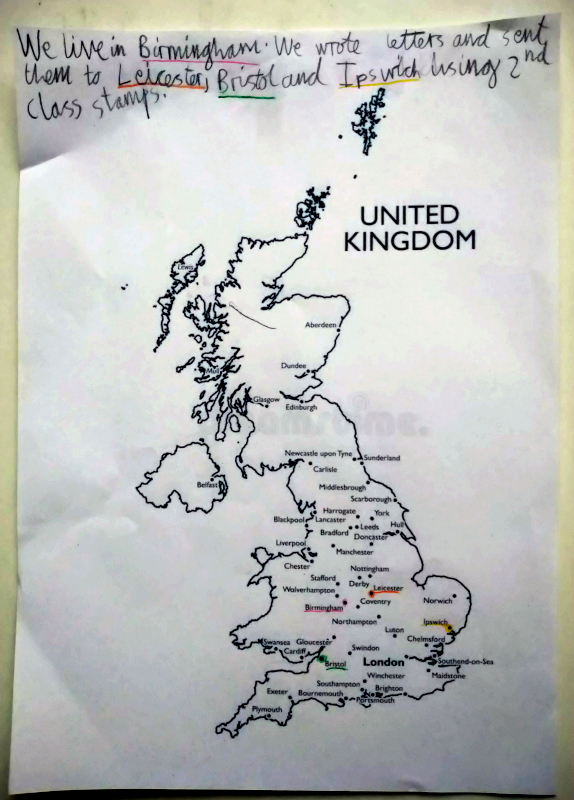

When the letters arrive InshaAllah they can add at the bottom how long it took for their aunts to receive them! They're expecting Ipswich to maybe take longer because it's the furthest away, and Leicester to be delivered the quickest, but we'll see. 😁

Wednesday, 5 February 2020

Greek Mythology (2)

I spent some time debating how much detail we wanted to go into Greek mythology at this point in time... I didn't feel the girls would enjoy the violence aspect of the adventures at their current age... And Ancient Greek culture is a good topic base for Art, Geography and History lessons, so I'd rather have the time to plan a unit in enough detail to do it justice rather than do a rushed job now. 😶

With that in mind, I decided to use this week just to focus on the myths we've already covered in the form of another shadow puppet theatre (subtly revising work on light and shadows at the same time!).

The girls chose to do the story of King Midas and the Golden Touch.

Before they could do their play, first I had them rewrite the story in their own words in script format. This sounds a bit daunting for a 6 year old but MashaAllah they managed with some structured help!

After rereading the version in the book and comparing it with a version online (ideally we would go to the library but unfortunately we're without a car atm!), I had the girls tell me what they thought were the main parts to the story. We wrote these on scrap paper so we could then rearrange them into chronological order when they were done (this also helped them see if they had missed any key events out when summarising the story).


I gave the girls a storyboard template so they could translate the bullet point version into a storyboard. This was also useful in getting them to think about what might be on stage at that point during their shadow play.


Next, I had them write out the text in their storyboards on a new piece of paper but adding more detail, paragraphs and direct speech so it flowed like a story - and made them think about what their narrator and characters might say during the play. I had them do this pretty much independently as I wanted them to come up with different versions - a good lesson in how even though we might have the same thing to start with (we all read the same stories), they wrote them again in different ways. Maybe this could be why many different versions of the same story exist? Considering how many thousands of years old the stories are and how many times they must have been retold and passed down!

When they were finished, we recapped editing skills (we had done work that week on conjunctions and fronted adverbials, so they were looking out for those in particular!) and they made changes in a different colour.


(They wrote the words "everything" and "excitedly" at the end as spelling practise since they had misspelt them in their writing. Just chose one for them to do.😗)

Finally, I challenged them to work together on the laptop to turn their stories into one playscript. They needed to think about the layout themselves and talk together to agree on which wording to use! I created them a file on Google Docs for this so I could help with editing on my new laptop (gift from my husband, MashaAllah 😁) - they were amazed how we could all edit the same file at the same time! But it was really convenient so I think from now on we'll continue using Google Docs over Microsoft Word, inshaAllah.


The above was done over three consecutive days.

For their shadow puppets, we talked about how they could show the things turning into gold - how could they make the shadows change colour? I prompted them to think about layering - as we had previously layered blue and yellow cellophane to create a green shadow for grass - which materials could they layer to turn an opaque shadow into yellow?

When they were done and had practised it a few times, we recorded the show (each scene as a separate clip) and edited it on the laptop using Shotcut into one long video.


Tuesday, 21 January 2020

Greek Mythology (1)

Since the books we have which contain fables also contain Greek myths, I thought it was better to cover them in more detail now since the girls are aware of them anyway... Rather than ignore them and let any seeds of confusion grow! Plus they come up in the Year 3 NC for Literacy.

We began by reminding ourselves who wrote the fables we had been reading - Aesop - and which country he was from - Greece. We talked a little about how he lived a very long long time ago (around 600BC, i.e. 600 years before Prophet Isa (AS) was born - which is what we call year 0 - so over 2,500 years ago!) and how we call that time period "Ancient" Greece.

They found Greece in the atlas (clue: it's in Europe...) and I asked them what they thought the climate was like and why - they said hot, M because their atlas showed olives growing there and F because it was near the equator! I gave them a printed map of Europe (from Google Images) to help familiarise them with it some more. They coloured the water first, following the coastlines and using islands as a starting place to know where the seas were, then coloured the UK followed by Greece and then other countries they had heard of with a key down the side - using their picture atlas to help.


We talked about how in those days, the Ancient Greeks didn't know about Islam. Instead of believing in Allah, they believed in lots and lots of different gods - male and female - who were all in charge of different things... So one was in charge of making things grow, one was in charge of turning night into day, one was in charge of people after they died, etc. etc. And the one in charge of them all was called Zeus. The gods and goddesses all lived together on a mountain called Olympus (the tallest mountain in Greece) where some married each other and had children and some had children with humans so the children were half-gods or demigods... MashaAllah the twins had such precious looks of disbelief on their faces as I was telling them about this! I asked them what we believe and MashaAllah they confidently replied that Allah made everything and is in charge of everything and He does not have children or partners, astaghfirullah!

Then we read through a few myths together (I wrote the word mythology on the board and explained myths is the shorter way of calling them) as examples. We used the Usborne book again, looking for Greek myths in the contents.

We read the story of King Midas followed by the story of Icarus. I asked the girls what fables are for - to teach a moral - and asked them why they thought fables and myths were together in their books... F said because Aesop lived in Ancient Greece so he wanted to write those kinds of stories. M said because they both have a lesson in them. So what were the lessons in these two myths? They came up with to not be greedy for King Midas. For Icarus, they said to listen to what you're told instead of being silly and having too much fun when you're not supposed to. 😂

Then we read the story of Persephone. Towards the end, F started laughing and asked was the story supposed to be explaining why we have winter? When I said yes she laughed more and told me no, we have winter because of the Earth going round the sun. 😜

Finally, we read the story of Pandora's box. F wasn't sure what the lesson was - don't be nosy? - but M understood it as explaining the reason why there are all the bad things in the world.

To finish, I asked them what they thought the features of Greek mythology might be. They came up with teaching a lesson - I clarified this could either be as a moral or explaining something about the world - and having Greek gods/goddesses as characters. They also said Greek myths didn't have to be as short and simple as fables were.

Throughout the rest of the week we watched episodes from Super Wings which were set in Europe, since the series was streaming on Amazon Prime at the time.

Friday, 17 January 2020

Geography Targets

Geography targets taken from the National Curriculum and converted into a spreadsheet table for individual tracking.

Download here.

Tuesday, 26 November 2019

Maps and Scales

Following on from our seerah work on the Isra' and Mi'raaj, I thought now would be a nice time to look at the big atlas (they've only used their junior atlas so far) and introduce them to the concept of scales.

First, we revised which units are used for measuring length/distance and compared them to each other i.e. how many mm in a cm, cm in a m, m in a km. So which unit would be the most sensible for measuring the distance between Makkah and Jerusalem? They chose km. 😁

Then I showed them the atlas and told them we could use it to calculate the actual distance between those two places. Nowadays, we can easily use the internet to find out the answer - but before that technology existed, this is what we would have done instead!

They used the contents page to help them find the right page in the atlas (they knew they needed to look in either Asia or Africa) and then found Makkah and Jerusalem on the map. I asked them to measure the distance - what would they need? A ruler. At first they tried to do it in cm and said "around 6cm", so I told them to use mm - which is another new skill for them today! M said 62mm and F 64mm, so I said we'd go in between and say it's 63mm.


So is the distance between Makkah and Jerusalem 63mm?? M laughed and said her hand was bigger than that! So I pointed out the scale at the bottom of the page and explained this to them: the map was drawn to scale so that every 1cm actually meant 200km in real life!

The next bit of maths I did on the whiteboard and had them help with the arithmetic, but I didn't expect them to follow along with the method... So we calculated that if 1cm = 200km then 1mm = 20km. 1mm x 20 = 20km, so 63mm x 20 = 1260km. So the distance between Makkah and Jerusalem must be around 1260km.

Was it? We typed it into Google to check and found the answer given to be 1486km! Which is pretty close! We'd recently done work on rounding, so I had them round the two answers to the nearest 100km, i.e. 1300km and 1500km, and they agreed these were pretty similar.

Next, I asked them to find the page of the UK so we could calculate some distances between e.g. Birmingham and Ipswich.

M found the page quickly and they enjoyed looking at the map for a few minutes, pointing out familiar places: Birmingham, Ipswich, Felixstowe, Woodbridge, Leicester, Nottingham (where Papa's at work today!), London...

Then they repeated what they did before, in turn, and measured the distance between Birmingham and Ipswich to be 106mm. They both agreed at the same distance this time.


I asked them if Birmingham and Ipswich were further away from each other than Makkah and Jerusalem then, because 106mm was more than 63mm? They both laughed and said no, of course not. 😂 I prompted them by asking if the scale of the maps on both pages was the same or different then and they correctly answered it must be different. 👍

We did some more calculations on the whiteboard (again, not expecting them to follow the method!) and worked out that Ipswich is 265km away from Birmingham. Google came up with 264.2km, which they were very pleased with! 😁😁

Finally, we compared the two distances with each other by rounding... So Makkah to Jerusalem was around 1500km and Birmingham to Ipswich was around 300km... So how many times more is the distance between Makkah and Jerusalem, i.e. how far Prophet Muhammad (SAW) travelled in one night compared to when we go to visit Nani's house? With a bit of prompting (mainly me scaling the numbers down by dividing by 100!) they were happy it was 5 times more.

So if it takes us around 3 hours to get to Nani's house by car, how long would it take us by car to get to Jerusalem from Makkah? F quite quickly understood we needed to multiply 3 hours by 5, so 15 hours. This gave them some kind of tangible idea of how far the Prophet (SAW) travelled and why the disbelievers found it so hard to believe him!

How long did they say it should take? 1 month, i.e. around 30 days by camel. So if we were to travel the distance to Ipswich by camel, as they would have done in those days, how long would it take us? This was a little more difficult but they worked out they would need to divide 30 by 5, since the difference in the journey length was 5 times, i.e. 6 days. Can you imagine taking 6 days to get to Nani's house! But nowadays we can just get in the car and drive in only 2.5-3hrs! 😱

We finished there, but I noticed the two of them poring over the atlas together while I was getting lunch ready, MashaAllah. 😆💕

Saturday, 2 November 2019

Summer of Year 1 - Autumn of Year 2

A list of some of the things we've done over the last few months... No time for proper updates! SubhanAllah, my youngest brother was diagnosed with stage 4b lymphoma and things were a bit busy and a lot of going back and forth between Bristol, Birmingham and Ipswich. Alhamdulillah, he's finished his chemo course and seems to be doing well (and MashaAllah, the work we've done in Science recently on infection and the human body was really useful in the girls being able to understand pretty quickly why I was upset to hear the news and why we need to make lots of dua that Mamu gets better soon). Next time we visit will be next month, inshaAllah. 😄

So aside from the usual Literacy and Numeracy, guided by the Year 2 NC (going through the list and filling in all the gaps), we did the following:

1) Definition of habitats: research in non-fiction books, identify from fiction books, create a poster of a habitat of choice (including marking locations on a world map) which contained examples of plants and animals found in that habitat. Rehearse and give a presentation of their poster to each other, giving feedback on how to improve, then give an improved presentation to Papa. Convert their posters to PowerPoints (skills: typing, text boxes, inserting images, animations) and show this as a presentation to Papa.


2) Art trail around Ipswich, looking for Elmer statues. Map reading, walking, exploring, checking off a list, art appreciation & discussion... The girls then designed and named their own Elmers on pieces of scrap paper and compiled these into a booklet each. They tried to copy the art trail Elmers and came up with puns where they could!

3) Visit to a working water mill, where they grind their own flour and make their own bread - Tide Mill in Woodbridge. We took the train there with Nani, which was an experience in itself! The mill itself was really educational and child friendly. Definitely worth a visit if you're in the area! The girls got to help start the water wheel by turning a handle and follow all the ropes and pulleys to the top of the mill. They were able to identify where the old pulleys should have been connected in the roof for the bags of flour to be lifted through the hatch, and also understood the mechanism behind the cogs turning and affecting each other. While there we also did some bird spotting from the lookout area and talked about how the mill was connected to the river. This led onto discussions to do with water sources and the sea, which inspired some more visits whilst in Ipswich...


4) We went to Felixstowe beach twice - once on the train with Nani during the daytime and another at sunset by car with Papa. Both experiences felt completely different despite being to the same place, which led to some good discussions. On our first trip they had fish & chips and ice-cream on the pier, played in the sand and F was brave enough to paddle in the sea. On the second trip we went for a short stroll on the beach and they played in the sand by the light of some coloured string lanterns hung across the promenade. It was interesting to watch the sunset on the horizon and see how the sky changed colour and then how the sea faded to black so it was impossible to tell where the sea ended and the sky began - the only clues the sea was there at all were a few lights from ships far in the distance. This led to talks about lighthouses and on how vast the sea is.

5) We walked down to Ipswich docks (only 5-10min from my parents' house!) and compared how the water was flowing to the river we saw at Woodbridge. Why? M had the idea that maybe both the water in the docks and the water from Tide Mill would end up in Felixstowe to meet the sea, so we checked on Google maps by zooming out and saw she was right! We didn't have time this visit to see, but I'd like to take them to Orwell Bridge so they can compare how the river looks there to how it was after the docks (and also to the little streams we saw in Holywells Park).


6) Which is the most popular car colour in Ipswich? The twins came up with a method of answering this question (watch the cars on the main road outside Nani's house) and keep a tally chart. We repeated this on two different days and compared the results (the same top three colours but not the same most popular colour on each day!) then turned these results into a bar chart (column addition practise to collate their results from both days). I helped them with this through prompts and questions and then wrote some simple questions about their data for them to answer.


7) We went to a free pizza making workshop at Pizza Express, organised by another home ed mum. The 3 eldest girls learnt a little about Italy and why a margarita has that name (the colours of the Italian flag represented by the toppings), tasted some pizza toppings then made their own margaritas on a pre-made base. The next week they wanted to make pizza at home from scratch, so I found a simple dough using Greek yoghurt and flour they could do independently. They made the dough themselves while I helped with the oven parts and making the sauce (tomato puree, oil & herbs). They put all the toppings on themselves and decided to make tuna, sweetcorn, mozzarella and cheddar.


8) Bake Off inspired baking: taking it in turns to bake cupcakes with me, one person each week. They designed their cupcake on paper first (sponge flavour & decorations) then baked with my guidance (they did measuring themselves for once!). After we all had a turn, we discussed which bake was our favourite and why. Mine was mint chocolate and my favourite lol - will need to post recipe soon inshaAllah!

9) First piece of extended writing in a while... We're currently reading the Famous Five series together and they're really enjoying them, so I used this as a basis for their writing. After a particularly eventful chapter, we did some hotseating on the characters' thoughts/feelings then I modelled writing a simple diary entry on A3 paper. Together, we discussed what the features of a diary entry might be and annotated them on the paper. Then the twins wrote their own diary entries as different characters from the book. When they thought they were finished, they referred to the poster and added to their work.


10) Bouncing ball investigation (as M asked why did the ball bounce higher in the kitchen compared to the sitting room?). Discussed in terms of energy (potential, kinetic) and energy being absorbed. Twins came up with ideas on how to test these factors (i.e. strength of throw, height dropped, floor surface) and how to measure - describe in words or use tape measure? Both ways difficult but tape measure was preferred option! One of the results didn't match our predictions, so we did some further investigations explore why. M came up with hypothesis 1 and F with hypothesis 2, with them both working together to think of how we could test each one. We put both ideas together to come up with a reason to explain why that one result didn't match.


Wednesday, 27 March 2019

Stories from other cultures - 4 - East Asia

My mum is ethnically Chinese, so another link to this part of the world as we continue our tour. My husband and I are also both (retired now after becoming parents it seems 😂) martial artists, so I wanted to use this opportunity to focus more on the idea and see if they were interested in learning too.

Maps, atlases, we discussed which countries we would focus on (China, Japan, South Korea)... Discussions on food (they had a go using chopsticks!), climate, clothing and beliefs... Lots of YouTube videos and library books...

I was pleased to find a book in the library on the origins of the Chinese Zodiac, beautifully illustrated in a calligraphic style with Chinese writing on some pages, so we talked a little about astrology with the reminder of what we believe in and why we don't follow star signs etc.

Another book featured a character based on origami, so we watched a couple of How To videos - but they weren't that interested so we missed the opportunity to try our own. 😁

As mentioned above, we looked at different martial arts styles from the different East Asian countries - namely karate (Japan), taekwondo (South Korea) and kung-fu (China) - talking about the differences in movement, which one was their favourite, and trying out a few techniques. F liked taekwondo because she liked the flips and M liked kung-fu because she liked it! 😂

Finally, we ordered dinner from a Chinese takeaway, including fortune cookies for the experience and also to talk some more about astrology and beliefs which are different to ours: you can respect a different opinion by being polite and friendly with the people who believe it and still believe something else.

With all the above this was quite a busy week in terms of activities so I chose not to do any formal writing with them. In the build up to Ramadaan and giving myself to prepare, I'm going to focus on word level and sentence level Literacy skills for the next few weeks inshaAllah - so just tidying up their basic grammar for a while rather than another big topic like this.

Saturday, 23 March 2019

Stories from other cultures - 3 - South Asia

This week, we looked at South Asia - concentrating on India, with some mention of Pakistan and Bangladesh. My husband's family originates from India and my dad was born in Bangladesh, so the girls have some links with these countries, too. But since the theme of this topic is other cultures, I wanted to focus more on the non-Islamic regions of India so as to broaden their knowledge a bit more.

As usual, we looked at our maps and atlases and read a load of traditional stories from the library. We talked about climate, clothes and food (with actual examples!), as well as a little about Hinduism (one of the books we took out, as an example of an Indian traditional tale, was the story of Ram & Sita and why people celebrate Diwali).

For our formal Literacy task this week, I had them write a description of a meal with traditional Indian food. We eat lots of this kind of cuisine anyway so I just encouraged lots of talk at mealtimes about the food, describing it using the five senses and what they liked about it. We also watched a few videos from this YouTube channel, which follow someone from Canada trying out different street foods from around the world. I was surprised how much the girls enjoyed watching them! F especially, I think she has her father's travel bug from the way her eyes lit up at the thought of travelling to different countries, mashaAllah. 😃✨


You can download our writing prompt here.

Monday, 18 March 2019

Stories from other cultures - 2 - The Middle East

Our next stop on our world tour was (North Africa &) the Middle East. 🌍

We went back to our globe, maps and atlas to find this region of the world, point out any familiar countries and read the names of others. We looked at the general climate, talked about deserts and discussed why some of the culture between the Middle East might be similar to areas of Northern Africa, such as Morocco.

I decided to use this week as a good opportunity to read some general stories of the Prophet Muhammad (SAW)'s life (e.g. from books such as this and this, which were hand-me-downs kindly gifted to us from a friend) as well as practise our Arabic reading and understanding by going through the relevant Big Cat books we have (1, 2, 3, 4, 5).

It was difficult to find any books from the library set in the Middle East, with the exception of Sanji & the Baker - which is a beautifully illustrated retelling of a well-known story which I love. 😁 We really got the most out of this book, talking about the clues in the pictures to tell us about the setting, the characters, etc. and a good discussion on the moral of the story, fairness and greed. 👍

As all these stories were set in the past, to remind them of what the region is like currently we rewatched some episodes of Iftah Ya Simsim - as it contains clips of children doing different activities in various Arab countries - and looked back through our holiday photos/videos to Istanbul and umrah last year. We also watched a random travel blog of some people camping in the Sahara!

As we didn't do a focused Literacy task last week, this week I decided to have them continue writing a story I started which was set in a desert:


You can download the story and template writing sheet here. (I included little cliparts on the second page as reminders of what was mentioned so far and so prompts for what they could include next. Excuse the pun in the title, too. LOL. But a good chance for a mini recap lesson on homonyms. 😂)

I wasn't so focused on their spelling, grammar or punctuation with this task, but more on their imagination, text structure and organisation. We talked a bit about what could happen next, but without me giving them any ideas - literally just a few questions about the cliparts and this on the whiteboard. Lol.


I then set the 30min sand timer on the table in front of them and let them write as much as they could, in silence, for that time.

I wasn't expecting them to complete the story with a lot of detail, but I wanted to give them that chance to free write with no interruptions or worries about "getting it wrong". For that reason, I gave them pens to write with so a) they wouldn't waste time trying to rub out mistakes and b) so it felt a bit more special. I had this video playing in the background as inspiration/to set the mood, and halfway through the time I stopped them so they could read and comment on each other's work so far. This helped as it gave them a short break as well as kept them focused on what to write next. The yellow highlighter shows where they got up to in the half an hour. As they didn't finish, I said they could complete it as and when they felt like it over the next couple of days - so it wasn't sitting in silence, but just writing a bit more for fun. This is what they ended up with! 💕

M

F
Finally, the plan is to go to a Lebanese/Moroccan restaurant so the girls can taste some of the foods from the region again. And as an excuse to go out. 😋

Sunday, 10 March 2019

Lapworth Museum

We visited Lapworth Museum to learn about skeletons and fossils in a little more detail - mainly to see the allosaurus on display!

The museum doesn't open until 12pm on a weekend (I thought it opened at 10am ) so we arrived on campus half an hour before opening time... But alhamdulillah the weather was fine so we used the time for a quick trip down memory lane - we walked through the university centre (where everything was closed lol) and up the stairs to one of the lecture theatres, but it was locked! And past the Old Gym (which isn't so old anymore!) where my husband and I met. 💕😂 The campus was pretty much dead when we arrived but by midday lots of people started arriving - so we used all this for a short discussion about uni life and student habits. 😀


Inside Lapworth, we looked at all the skeletons on display - revising our work on herbivores/carnivores and using fossils for clues. F had recently asked if there were any flying dinosaurs to which I'd answered pterodactyl, and fortunately there was one on display hanging from the ceiling.

allosaurus cast

pterodactyl cast

allosaurus skull - feel its teeth!

another carniverous dinosaur...

hippopotamus skull

Most of the exhibits just showed parts of the skeleton as opposed to the whole thing, eg the femur of a stegosaurus, so there were some good opportunities to revise bone names and find the equivalent on their own bodies.

Surprisingly for me though, the part of the museum they enjoyed the most was looking at all the different rocks and gemstones upstairs!

rock wall - feel and describe their textures!

my favourite stone because it's my favourite colour~
their feedback in the bottom right!

We managed to look around the whole museum comfortably in just over an hour. Definitely somewhere worth visiting again next time we're on campus or when it ties in with another topic inshaAllah!

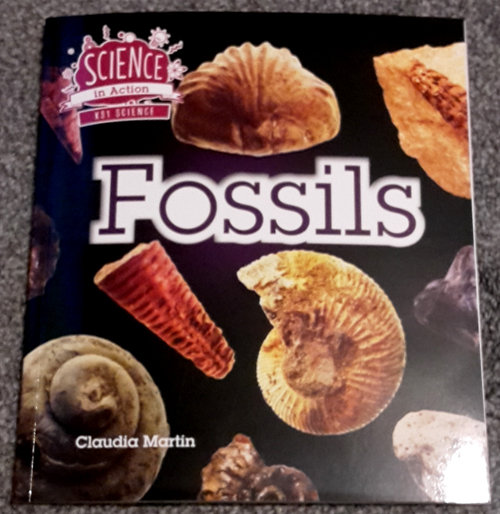
When we got home, I put out the Fossils book we have:


I really like this book series, but this served as a reminder how careful we need to be with the educational material we give to our children - especially when it looks like a trusted source - since the last few pages of the book are dedicated to the theory of humans evolving from apes and present it as non-disputable fact:


I don't wish for the girls to grow up sheltered, so I thought since it came up we may as well discuss it. Rather than censor the page completely, I decided to stick some flaps over the top instead with the following:


So the girls can still see the information underneath, but they can treat it in the same way as they treat beliefs from other religions.

We also spoke a little about scientific theory and how the principle is correct, to have a prediction and look for evidence (just like we do for our experiments!), but how important it is not to have preconceived biases or we end up with the wrong conclusions.