Showing posts with label story. Show all posts

Tuesday, 16 April 2019

99 Names of Allah - 09 - Al-'Azeez - The Mighty

[09] اَلْعَزِيزُ (Al-'Azeez): The Mighty

[Download resources here]


Sing 99 Names (5min)
Play PowerPoint of the first 33 names, 2-3 times. Sing together and do the actions so far plus:

Action for Al-Azeez: Fist pump the air with both hands and then pose with both arms bent to mime being a strong winner.

Today’s focus is on the name Al-'Azeez which means The Mighty.

Story relating to today's name (7min)
Read the following short story to the children (printable copy in the resources file):

Mighty Brown Bear & the Tug-of-War

In a certain forest, a long time ago, there once lived a group of animals with a strange rule between them. Every month, on the night of the full moon, all the animals would gather together for a grand tug-of-war tournament. The winning animal - the strongest animal - would earn the prize of becoming the next king or queen of the forest. As the mightiest animal in the forest, they had the difficult responsibility to make sure everything was in order and running smoothly; but as ruler, they also had the luxury of eating any food in the forest, whenever they wanted, and no one could refuse them.

The forest animals lived happily this way, with kingship passing regularly between the strongest five: Golden Eagle, Silver Stag, Black Badger, Copper Beaver and Red Fox. They took turns to rule the forest with might and justice.

...All until one day. The day Brown Bear came. 

Brown Bear was large. Brown Bear was strong. Brown Bear arrived in the forest on the night of the full moon. He saw the animals' tournament. "Are you playing tug-of-war?" he asked. "I want to join in, too!"

Yes, Brown Bear was very strong indeed. So strong, that on the very first night he came to the forest, he won their tournament with ease and went to sleep as their new king! 

Brown Bear, however, was not a very good king. He was a glutton, irresponsible, and he was forgetful... So instead of helping sort out the animals' problems, and keeping the forest running smoothly, he chose to spend his days eating instead. No matter how much the animals complained, they could not win against him in a tug-of-war match, and so each month he stayed as king and each month the other animals became more and more upset. Brown Bear didn't mean to cause problems, he was just too greedy and he was just too lazy! 

Every month, at the tug-of-war tournament, the same thing happened. Golden Eagle beat his wings with all his might, but he could not win. Silver Stag heaved his giant antlers with all his might, but he could not win. Black Badger dug her sharp claws firm into the soil with all her might, but she could not win. Copper Beaver used his great tail to beat the ground with all his might, but he could not win. And Red Fox gnashed her teeth with all her might... But she could not win.

"If the strongest five cannot beat Brown Bear," the forest animals despaired, "then none of us can! He will stay our king and we will stay miserable forever!"

But one day, clever Red Fox thought of a plan. She called Golden Eagle, Silver Stag, Black Badger and Copper Beaver to a meeting - for over the many months of Brown Bear's reign, the strongest five animals had become good friends. 

The next night of the full moon, Brown Bear was going to get a surprise...

It was time for the tournament to begin. The moon shone high above the forest, bathing everything below in its gentle, white light.

Brown Bear came out yawning, holding one end of the rope. "Who's first?" he asked the crowd. "Let's end this quickly so we can go to bed and I can wake up early tomorrow as king again - the bees have been busy today and I can't wait to take the honey from their hive!" He licked his lips dreamily. 

"I'm first!" called a voice, and Red Fox stepped forward to pick up the other end of the rope. 

"I'm first!" shouted Copper Beaver, holding onto the rope behind Red Fox. 

"I'm first!" announced Black Badger, taking her place behind Copper Beaver.

"I'm first!" bellowed Silver Stag, wrapping his antlers in the rope behind Black Badger. 

"I'm first!" screeched Golden Eagle, clutching the end of the rope in his talons behind Silver Stag.

"You can't all be first!" blinked Brown Bear, not sure what to make of the five animals before him. "I thought the winner became king and you can't all be king at the same time!"

"Yes, we can!" the five replied and they all started pulling: teeth, tail, claws, antlers and wings against the mighty Brown Bear. And no matter how tough Brown Bear was, of course he couldn't win against the five strongest animals at once!

"We win!" Red Fox called out to the forest, "So we will share king and queenship between us! Golden Eagle will look after the trees. Silver Stag is in charge of the meadows. Black Badger will watch the underground, Copper Beaver the rivers, and I will take the bushes and undergrowth. Does anyone have any problems?"

The forest animals cheered with delight. Only Brown Bear looked sad.

Red Fox continued, "Brown Bear, you may think it unfair of us to have worked together, but you are simply too strong and we could not win against you otherwise. You are still the mightiest animal in the forest. So what do you say, as your special privilege, you can carry on helping yourself to any food from the forest - but the job of keeping everything is in order is left to us?"

Of course, Brown Bear agreed! All the food he could want without any pressures of work! And he was very happy about it, too. In fact, all the animals were so happy with the new arrangement that when the next full moon came round, they voted to stop the tournaments altogether and to leave things how they were.

And so they all lived happily ever after. 

...Especially Brown Bear, who could eat as much honey from the trees, grass from the meadows, fruit from the bushes, roots from underground and salmon from the river as he wanted.

Brown Bear was the mightiest animal in the forest – and he was mighty happy about it, too! 

Discuss meaning, apply to children's lives (15min)
Al-'Azeez means The Mighty.

What do you think the word "mighty" means? Really, really strong and powerful - usually because of size... Just as Brown Bear was the mightiest animal in the forest.

Allah is the most powerful and the strongest - if Allah wants something then nothing can stop it. Allah can never be defeated.

Play tug-of-war game with the children, one at a time (or something else you know you're better at e.g. Snap). Win on purpose and ask who is mightier, you or them? But does that mean they could never win against you? No, as they get older and bigger or if they practise more or if you aren't paying attention (make a mistake and drop the rope!) then they could win! But if anyone or anything tries to go against Allah, it doesn't matter how much they struggle, Allah always wins. And of course, Allah would never make a mistake and lose (remember, He is As-Salaam, The Flawless!).

If there is more than one child, play tug-of-war again with them all against you - or just talk about it. If you add more people, like in the story where the five animals went against Brown Bear, what could happen? Could more people win by working together? But even if all the people in the world wanted to do something against Allah’s will, and all the people in the world worked together... Could they ever win? No!

Discuss: When you lost, did that make you not like me? Maybe a little bit? But this name of Allah doesn't just mean the most mighty and impossible to win against, it also means the most cherished. Do you know what cherish means? It means to love something and want to keep it close to you. So even though Allah is the most powerful, we never feel like we don't like it when what we want is different to what Allah wants, we still always love Him. Because remember, Allah plans things and knows things we don't know - things always happen for a reason even if we don't understand Allah’s reason. (Remind of 6 articles of faith and the qadr of Allah, if appropriate)

Craft activity (20min)
Complete the page for the book.

Imagine trying to play tug-of-war with a mountain - wouldn't that be ridiculous! You could never pull a mountain hard enough to make the whole thing move. And Allah is even stronger than the strongest thing you can imagine. There's nothing in the whole universe which could go against what Allah wants to happen. 

Let the children colour and cut out the name, meaning and picture of a mountain. Tie a knot in a piece of string and stick it down as if it's been tied around the mountain - to remind the children of the tug-of-war analogy. 

When to use this name (8min)
Allah is the source of all strength.

Can you think of a time you might need strength?

What about a time when you don't need physical strength, but emotional strength? e.g. standing up to someone being mean to you, having the strength not to give up on something difficult...

Al-Azeez is the All Mighty. Trust that He will always win and the way of Islam is correct. Always hold strong onto your faith.

On the back of their page, help the children write a few thoughts about the name Al-Azeez and their feelings.

Sticker chart (5min)
Ask individually: Which of Allah’s names did we learn today? What does it mean? Give children a sticker each for their chart.

----------

Other activities:


-     Create a collage of things the children cherish, using pictures they draw themselves or pictures from the internet/magazines/etc.  to help remind them this name is linked to not just the most mighty, but also the most beloved.

-     Let children design their own superhero with super strength – age, gender, costume, etc. – and draw a picture of them. They can then use this character in a role play or write a short story/scene where their hero saves the day with their super strength.

-     Play tug-of-war with all their family members, one-on-one including parents! Work out who the mightiest family member is, or for an extra challenge design a tournament to find out the order of all the family members.

Please leave a comment if you have any other ideas to add!

Saturday, 15 September 2018

The story of Prophet Adam (AS)

The girls are already familiar with the Prophet Adam (AS) from their children books, but I just wanted to go through it myself to make sure they understood that being sent to Earth was NOT a punishment - unlike what Christians believe - as is told in the Quran how Allah told the angels He was going to create people and put them on Earth. I also wanted to make sure they were able to recall the main parts of the story themselves from memory.

I wrote the story in language suitable for 4-5 year olds, while still retaining as much meaning/original translations from the Quran as possible, after making notes from a variety of sources (including Tafsir Ibn Kathir and lectures from speakers such as Mufti Menk and Nouman Ali Khan).

PROPHET ADAM (AS)

A long, long time ago, Allah created the world. He created the sun, the moon and the stars. He created the seas and the mountains. He created the trees and the flowers. He created the fish, the birds and the animals. Allah created everything.

Up, up, high above the sky in the heavens are the gardens of paradise: Jannah. In Jannah you never feel hungry, thirsty or tired. You have no reason to feel pain or sadness. In Jannah, Allah spoke to the angels. He told them He was going to create humans and put them on Earth to live and look after it. The angels praised Allah day and night; they always obeyed Allah but they didn’t understand why Allah wanted to make humans. The angels were worried humans would fight with each other and spoil the Earth. The angels worshipped Allah so much they didn’t understand why people were needed to worship Allah too! But Allah simply said to them, “I know what you do not know.”

Allah created the first man, Adam, from a handful of clay gathered from all the Earth: this is why humankind is all different colours and with all different personalities, just as the mud from around the world is different. Some people are kind and generous, some are selfish and mean, some are in between. Some are evil, some are good and some are in between.

Allah created Adam with his hands and blew his soul into him. When the life entered Adam’s head, he sneezed and the angels told Adam to say, “Alhamdulillah.” When he did, Allah replied, “Yarhamukhallah.” This is what we should say when we sneeze and reply when someone else sneezes.

When Adam was sent to greet a group of angels, he said to them, “As salaamu ‘alaikum,” and the angels replied to Adam, “Wa ‘alaikum as salaamu wa rahmatullah.” This is the way we should greet and reply to people we meet.

Allah taught Adam the names of all kinds of things, such as trees, mountains, the sea, camel. Allah showed these things to the angels and asked them to name them, but the angels could not. They said to Allah, “We only know what you have taught us.” Allah then told Adam to tell the angels the names of all the things. When Adam finished, Allah said to the angels, “Did I not tell you I know the secrets of the heavens and the earth, and I know what you show and what you hide?”

Amongst the angels, there was one Jinn who had been raised to a special rank in the heavens. His name was Iblis. When Allah told the angels to bow down to Adam, they all obeyed except for Iblis.

Iblis was too proud and arrogant. He said to Allah, “Why should I bow down to him when I’m better than him? You made me from fire and him just from clay!”

Allah said to Iblis, “Then get out from here. You are rejected and cursed. The curse shall be upon you until the Day of Judgement.” Allah threw Iblis out from the gardens of Jannah.

Iblis said to Allah, “If you let me go until the Day of Judgement, then I will lead his children to the wrong path – all of them but a few!” Allah let Iblis go and told him that any people who follow Iblis’ evil whispers will be sent to the hellfire… But Allah also told him that Muslims who worship Allah and do good things can never be led wrong by Iblis.

Prophet Adam was sent to live in Jannah but because he was the only human he began to feel lonely. While Adam was sleeping, Allah created the first woman, Hawwa (or Eve) from Adam’s rib. When Adam woke up he was surprised to see her sitting beside him, but he was also happy to have another person for company.

Allah told Adam and Hawwa they could eat and enjoy anything they wanted from the gardens of paradise - all except from the fruit from one particular tree. If they ate the fruit from that tree, Allah warned something bad would happen to them.

Allah told them that Iblis was Adam and Hawwa’s enemy. Iblis didn’t want Adam and Hawwa to stay in Jannah. In Jannah, you will never feel hungry or thirsty, too hot or too cold. Iblis was jealous of Adam and Hawwa.

Iblis whispered lies to Adam and Hawwa, to trick them into eating the forbidden fruit from the tree. Iblis told them he was their friend. He lied and said, “If you eat from the tree, you can become angels and live forever.”

Adam and Hawwa ate from the tree. As soon as they did, they felt ashamed and naked. They quickly hid themselves behind fig leaves to cover their shame.

Allah asked Adam and Hawwa, “Didn’t I tell you not to eat from the tree and that Shaytaan is your enemy?” Adam and Hawwa admitted their mistake and asked Allah for forgiveness. They made tawbah. Allah is most merciful and kind.

Allah sent Adam and Hawwa down to live on Earth, along with Iblis. Iblis wants to lead us away from remembering Allah, but Allah has promised us if we worship Him and do good deeds then one day we will be able to return to Jannah.

You can download the above story as a MS Word file here.

After reading the story to the girls (in an interactive way, asking questions and letting them ask questions), I asked them what they thought the main points were - just what they could remember regardless of where it came. I wrote these as a spider diagram on A4 coloured paper. Once they had them all, with some prompting, I asked the girls to put the points in chronological order by numbering each one.

***find photo***

I then gave them a storyboard with the story summarised into six sections and told them that a summary is when we don't give the whole story, or every single bit of information, but just tell the most important points - like how they summarised it in the spider diagram. We read through the storyboard together, then I asked them what they thought might go in the big empty boxes? Pictures! But are there some things we aren't allowed to draw? Can we draw Allah, or the angels, or Shaytaan or Adam (AS) and Hawwa (RA)? So we talked about what they could draw in each box which wasn't any of those things, e.g. Allah's creations, clay, fire to represent jinn, gardens, a tree, Earth.


Finally, I asked them if they thought the story needed a little bit more detail - then we worked through each box in turn so they could add something extra, using the notes from the spider diagram to help. I decided to let them try spelling everything themselves then showed them any corrections once they'd done.

MashaAllah, I was pleased they clearly understood that being sent to Earth was planned from the beginning, in one of the twins' words: "It wasn't a punishment because Allah already said He was going to put them on Earth even before he made Prophet Adam! And they said sorry!" 💕

We did this whole lesson over a couple of days.

You can download our storyboard template here.

Sunday, 8 April 2018

Prophet Ibraheem (AS) - 07 - Building the Ka'bah

This is the last part of Prophet Ibraheem (AS)'s story I wanted to cover in the Reception year: how he and his son, Ismail (AS), built the ka'bah.

We read pages 40-44 together in the Migo & Ali book followed by pages 125-127 in the My First Quran Storybook, discussing the story as we went along.

I decided to do a few activities relating to this part of the story.

First, we reminded ourselves of which 3D solid the ka'bah is, i.e. a cube, and what the properties of a cube were: 6 square sides/faces all the same (thinking about other examples of cubes around the house, e.g. dice, boxes, to help). Then we talked about how we could build a model of the ka'bah using our Duplo blocks. Which blocks would we need? Which part did Prophet Ibraheem and Prophet Ismail build first? What shape would the base need to be? How tall should we make our model? How could we make the roof? I watched them work together to build their cube, prompting with questions along the way.


When they'd finished, I showed them some photos of the ka'bah and how its outside sometimes looks different, i.e. the design of the covering and how the cloth is sometimes lifted up, but in all the pictures the ka'bah is the same cube shape. I also pointed out where the black stone (hajar al-aswad) is situated, on the Eastern corner next to the door, and where the Station of Ibraheem (Maqam-e-Ibraheem) is, i.e. the stone Prophet Ibraheem (AS) stood on to build the upper walls. They remembered our recent Umrah trip and mashaAllah could link the experience with our lesson. 💕

I found all the images on Google, but you can download the pictures we used here.

I asked them how we could make our model look more like the real ka'bah and we talked about the covering being made from cloth... So we used a small black cloth to cover our model. (While I went upstairs to find some, I gave them the task of adding the Maqam-e-Ibraheem to their model; what colour/size/shape block could they use and where should it go?) After draping the black cloth on top they said it was still missing something: gold decorations! So we tied some gold ribbon across the top. We'll leave this model ka'bah for a few days for them (and their younger sister!) to include in their imaginative play - until they want to build something else. 😂


The other activity I did with them was to introduce the idea of 3D solids being built from 2D nets. I found an old cardboard box (food packaging is good for this) and asked them what shape it was: a cuboid/rectangular prism. Was it 3D? Yes! Then I showed them how to carefully open it out flat. Was it still 3D? No! How many faces does a cuboid have? Can you see the six different faces? Two smaller rectangles, two medium rectangles and two larger rectangles? I highlighted the pairs of faces in different colours and showed them how to fold it back into a cuboid again, then explained that we could do the same thing for a cube and this 2D pattern is called a "net".


I asked them how many faces a cube had and what 2D shape they were, so what might they expect the net of a cube to look like? Then I gave them a pre-drawn net of a cube each to cut out. I decided not to include the flaps at this age as I thought they might complicate things/be too fiddly for them. We talked about which lines they needed to cut across (not all of them!) then I highlighted the edges as a guide.


Once they'd cut the net out I helped them crease along the lines then asked them to try and fold it into a cube...


We compared our paper cubes with the cuboid from earlier... Which was stronger? Why? How could we make our cube stronger and how could we make it look like the ka'bah? After some discussion they decided they needed some black card. 💪 (This was our Science link and thinking about different materials 😀)

They stuck their paper templates (new vocab!) onto the black card and cut their net out again. I helped them fold the edges again, then we used sellotape to stick the sides together and decorated our models with strips of gold paper.


You can download our net of a cube here.

I was going to leave it there, but they wanted to put something in their folders... 😂 So I printed out a couple of the photos so they could summarise that part of the story and what they did!


You can download our worksheet as a template here.

Sunday, 25 March 2018

Prophet Ibraheem (AS) - 06 - The Sacrifice


We read about Prophet Ibraheem (AS) being told to sacrifice his son (this time we used My First Quran Storybook, pages 114-117, as this part of the story isn't included in the Migo & Ali book we've been using so far) and discussed the story along the way, including how Prophet Ibraheem (AS) and Ismail (AS) believed in Allah so much and how they weren't afraid - comparing to how the twins might feel in the same situation!

As a simple reminder, I found a clipart of a ram online and printed it out for the girls to colour and glue pieces of wool onto, after sticking onto their choice of coloured A4 card. Even the toddler joined in! Then they both wrote a sentence to summarise what they had learnt.

Monday, 19 March 2018

Prophet Ibraheem (AS) - 05 - Ismaeel (AS) and the Zamzam


For this part of the story, we read pages 37 to the top of page 40 in the Migo & Ali book - covering when Prophet Ibraheem (AS) left his wife and baby son in the desert and how the well of zamzam water was found. Again, this was something they were already a little familiar with through previous work, stories and discussions to do with Hajj and Umrah - but to keep with the chronological order of the topic I felt there was no harm in revisiting it.

To recap what happened, we made a simple pop-up craft using A4 card. I prepared the pieces in advance: a horizontal piece of yellow A4 card with a 75mm tall strip glued at the edges a little up from the bottom, the outline of a fountain (about 50mm tall) cut out from blue card, the outlines of hills cut out from brown paper, 2 coloured lolly sticks (I didn't have blue or would have used those!). If your children are more artistically inclined than mine, you may like to let them create these parts themselves!

On the first day, the twins painted the bottom part of the card as well as the strip going across brown (cue revision of which colours from our paints mixed to make brown and demonstration of how changing the ratio of red/yellow/green changes the hue - though by the time they were done it was all one shade of brown anyway 😂) - to represent the desert sand. I would have liked to use sandpaper or craft sand, but we didn't have any to hand so insha'Allah next time! They also coloured in the zamzam water using blue glitter glue pens. We talked about what happened in the story as they worked, then left everything to dry overnight.

The next day, they glued the hills down (recap what Prophet Ibraheem's wife had to do and why, so where did they think they should place the hills on their paper?) and sellotaped the zamzam water to the top of the lolly stick.

Asked them to tell me where the zamzam spring came from and how - then I showed them how to thread the lolly stick under the strip going across so it could move up and down. I then helped them put a strip of sellotape either side of the lolly stick at the bottom of the strip of card, so the stick wouldn't move side to side.

Finally, I asked them what the two hills were called and the twins labelled them with their names.

Saturday, 17 February 2018

99 Names of Allah - 05 - Al-Qudduus - The Pure One

[05] اَلْقُدُّوسُ (Al-Qudduus): The Pure One

[Download resources here]


Sing 99 Names (5min)
Play PowerPoint of the first 33 names, 2-3 times. Sing together and do the actions so far plus:

Action for Al-Qudduus: With open palms, wipe one hand across the other.

Today’s focus is on the name Al-Qudduus which means The Pure One.

Story relating to today's name (10min)
Read the story, “The Cleanest Country in the World.”

The Cleanest Country in the World

Once upon a time there were two boys. Their names were Nazeef and Aneeq. They lived in a country which was famous all over the world for being neat and tidy… And both Nazeef and Aneeq were famous in their country for being exceptionally neat and tidy. Their clothes were always spotless, their nails trimmed and never a hair on their heads out of place. People always said that no-one was cleaner than Nazeef or Aneeq! But who was cleaner? Well, nobody could decide!

One day, the king heard news that a very important lady would be coming to visit their country. She wanted to meet the cleanest person in the kingdom, because whoever it was would surely be the cleanest person in the world! But even after a lot of talking and arguing nobody could decide who it could be… Was it Aneeq or was it Nazeef? In the end, there was only one way to find out. The king decided to hold a grand competition to find out once and for all.

The news of the competition spread far and wide. Everyone in the kingdom was excited. Balloons were blown up, banners were made, bunting hung from all the windows; the largest hall in the castle was decorated and set up ready for the contest – two of each thing, one for each boy, was placed equally on either side of the hall: tubs of water, brushes, mirrors, soaps, towels and combs among many other things.

The king sat on his throne at the top of the hall. Crowds of people cheered and clapped from the sides. Nazeef and Aneeq stood, ready, at the start line. The competition was simple. A trumpet would be blown and the castle guards would throw a bucket of dry mud and sand over the two boys. Then they would have 20 minutes, until the trumpet were blown again, to use the things laid out to clean themselves as best as they could. Whoever was the cleanest at the end of the time would be the winner – and the king himself would be the judge.

Aneeq and Nazeef got ready. The trumpeter put the trumpet to his lips. The crowd held their breath in excitement…

When suddenly, the doors burst open! Everyone turned to see who would dare to interrupt such an important contest!

…It was none other than the very important lady!

“Wait! I wish to watch the contest,” the old lady called out to the hall. Without waiting for an answer, she walked calmly to the king’s throne. “I also wish to be the judge and-“ she bent forward and whispered something else quietly to the king.

The king was surprised and confused, but he couldn’t refuse the request of such an important guest. He called his guards to bring the important lady a large chair. Then he called five more guards and gave them another order. The guards quickly ran out into the hall and took away half of the items – there was no longer two of each thing neatly laid out, but only one of each! The people around the hall gasped and chattered. What could this mean?

The trumpet blew. The competition began. Nazeef and Aneeq were covered in a cloud of dirt and dust which made them cough and cover their eyes. Then they both rushed forward to where a large tub of warm water stood. Nazeef paused and Aneeq roughly pushed him to the side. There wasn’t time to stand and wait!

At each place in the hall, Aneeq would make sure he was first – snatching the towel before Nazeef could reach, blocking the mirror so Nazeef couldn’t see… Once, he even grabbed the back of Nazeef’s shirt to stop him from getting to the comb! Nazeef fell down but Aneeq didn’t stop to help; he was far too busy making sure he would be the cleanest and the winner!

Finally, the trumpet blew again. The competition was over.

Both boys stood spotless in front of the king and the wise old lady. Somehow, despite all the pushing and snatching, Aneeq and Nazeef still managed to be just as clean as each other.

The king stroked his beard thoughtfully and declared, “My, my… Nazeef and Aneeq, you really are the cleanest boys in the kingdom. I still cannot decide between you! I think it must be a draw.”

The audience clapped and cheered for they couldn’t see any difference either! But the wise old lady held up a hand for silence.

“Wait,” she said. “These boys may look the same to our eyes, but I cannot agree this to be a draw. Nazeef is the winner.”

Everyone was surprised, especially Aneeq. How could Nazeef be the winner? Both boys were perfectly clean! Not a speck of dirt remained on either.

“Let me explain,” the old lady continued. “Think carefully about their actions, not just how they look. Which boy behaved kindly, waiting his turn and not losing his temper? Which boy was rude, snatching and pushing? They may look the same on the outside,” the wise woman tapped her heart, “but their insides are definitely not the same.”

Aneeq hung his head in shame. He knew the old lady was right and he apologised to Nazeef. “I’m sorry for forgetting my manners. You should be the winner. Thank you for showing us all what it really means to be clean both inside and out.”

Nazeef shook Aneeq’s hand then they both hugged. The people in the hall burst into cheers once more, the king clapped loudly and the wise old lady smiled proudly. It looked like Aneeq had been quick to learn his lesson and they had all finally found the cleanest person in the kingdom!

From that day on, the country was sure to follow Nazeef’s example. Now they weren’t only famous for being neat and tidy people on the outside – they were also famous everywhere for having the best manners and the kindest actions. It truly was the cleanest country in the world.


THE END


Were both Nazeef and Aneeq neat and tidy? Why was Nazeef the winner? What do you think the wise old lady whispered to the king at the start of the contest? (To take half of the things away) Why? (To see how the boys would behave because they would have to share the things)

N.B. For those learning Arabic, the names are both adjectives: Nazeef (نَظِيفٌ) means clean, tidy, etc. and Aneeq (أَنِيقٌ) means clean, neat, stylish, etc.

Discuss meaning, apply to children's lives (10min)
Al-Qudduus means The Pure One because Allah is perfect in every way – everything about Him is good. The word “pure” means perfectly clean. It has nothing else at all mixed in with it which could make it dirty.

Can you think of ways you can make yourselves clean?
e.g. bathing, washing hands, water after using the toilet, brushing teeth, cutting nails, etc. Having clean clothes, wiping the bottom of your shoes, tidying your bedroom, etc.
What about clean actions, like in the story?
e.g. no hitting, no stealing, no bad words or lying, etc.

Did you know that if we do something bad, maybe by accident, it makes our hearts dirty? But Allah (SWT) and the Prophet Muhammad (SAW) have taught us ways we can keep our hearts clean. We can say sorry for anything bad we have done, not only to the person we did it to but by praying to Allah and promising Him we don’t want to do it again. Praying to Allah and reciting Quran also cleans our hearts.

Craft activity (20min)
Complete the page for the book.

Cut and stick the pictures to make a collage of things we can do to keep clean. Children can also draw their own pictures if they wish.

When to use this name (10min)
As Muslims, we should try our best to keep both our bodies clean and keep our hearts clean. Allah (SWT) even says this in the Quran, for example:

وَاللَّهُ يُحِبُّ الْمُطَّهِّرِينَ
 [9: 108, Surah At-Tawbah: Ayah 108] which means “Allah loves those who purify themselves.”

And a famous hadith of the Prophet Muhammad (SAW) says:

الطَّهُورُ شَطْرُ الْإِيمَانِ
[Sahih Muslim] which means “Cleanliness (or purity) is half of faith.”

In both of these, cleanliness doesn’t just mean being clean on the outside but on the inside too. Help the children read the Arabic and put the ayah and hadith somewhere on display.

On the back of their page, help the children write a few thoughts about the name Al-Qudduus and their feelings.

Sticker chart (5min)
Ask individually: Which of Allah’s names did we learn today? What does it mean? Give children a sticker each for their chart.

----------

Other activities:

- Show children how to make wudhu and let them copy. Even if they don’t remember the whole sequence, let them enjoy playing with the water and feel good about copying the actions.

- Fill a small tub with lukewarm water. Let the children give one of their toys a bath. If they want to, they can pretend to do wudhu with their toy!

- Discuss how being clean can also mean being hygienic: when we keep ourselves clean it can help stop us from becoming ill, e.g. washing hands before eating, sneezing into a tissue, etc. So not only does it make Allah happy, it’s also good for us too! Could go on and link to germs and disease if children are interested.

- Use white and red/pink Lego/Duplo to build a model mouth, or laminate a picture of a smiling mouth. Colour some of the teeth with brown, yellow and black whiteboard markers. If using Lego, slide a few strips of paper between some of the teeth. Children can use an old toothbrush and pretend toothpaste (warm soapy water) to clean the teeth.

- Show children the proper way to wash their hands, lathering up the soap (without being wasteful!) and cleaning both the front and back of the palms as well as in between their fingers.

- Fold a piece of red/pink card in half and cut into the shape of a heart so it can open on one side. Prepare some small black circles and put Blu-tac on the back of each one. On the front of the heart the child can decorate it/write their name, etc. Then remind them how bad actions can put black spots on the heart – discuss some things which aren’t liked by Allah and have the child stick the black spots inside. Close the heart and talk about how we cannot see the black spots but they’re still there. Then remind them how they can clean their hearts and remove the spots one by one. Close the heart and say how it still looks the same on the outside, whether there are spots or not, but only you yourself and Allah know if they’re there or not. We should try our best to keep our hearts clean and if we’re not sure if we’ve made a mistake then it’s always best to recite lots of Quran and do good actions anyway! Because we’re still getting reward from those things regardless.


- Either role play using soft toys/puppets or prepare and print out some pictures showing different scenarios, e.g. playing football and falling the mud, pushing somebody over because they’re in the way, doing a lot of exercise and getting all sweaty, breaking a toy and then lying about it, eating spaghetti and getting sauce all over their clothes and face, having an argument with someone and calling them a nasty name, etc. Ask children if the person is being clean and what they can do to make themselves clean/what they should have done instead. Emphasise that it’s ok to get yourself dirty e.g. when playing outside or painting, etc. There’s nothing sinful about it! But when they’ve finished they should always try their best to clean themselves up.

- Together with your child, research some more hadith on cleanliness. Or prepare and print some hadith in advance for the children to make a poster collage out of, or if they’re learning Arabic to match up the English translation with the Arabic hadith (with some help!).

Tuesday, 6 February 2018

Prophet Ibraheem (AS) - 04 - In the Fire


Before continuing with the story of Prophet Ibraheem (AS), I read the story of Frances the Firefly to the twins (a story I remember from my own childhood! Though that was linked with fireworks and Bonfire Night 😅) and we talked about the dangers of fire and how horrible it would be if our homes burnt down or we were trapped in a fire. Then I lit a match for them to see - with VERY (!!!) careful supervision they didn't actually touch the flame, they put their finger close enough to feel its heat.

Later, we read the next part in the Migo & Ali book (pages 30-36) and discussed it as we went along: what they thought about what happened, how it made them feel, etc. They related it to our previous discussions from reading about Frances the Firefly and looking at the match.

Then I gave them a worksheet each to fill in the gaps (they took it in turns to read each sentence and we talked about what could go in the blank - then they each wrote their own version of the answer) and the option to colour in the fire at the bottom. You'll notice it didn't matter if their fire looked realistic or not, it's more to do with the process to aid with their memory of the story. 😂

You can download the worksheet template here.

Saturday, 18 November 2017

Prophet Ibraheem (AS) - 02 - Who is Allah (SWT)?


We read pages 26-27 about Prophet Ibraheem (AS) in the Migo & Ali book, discussing it together as we went along.

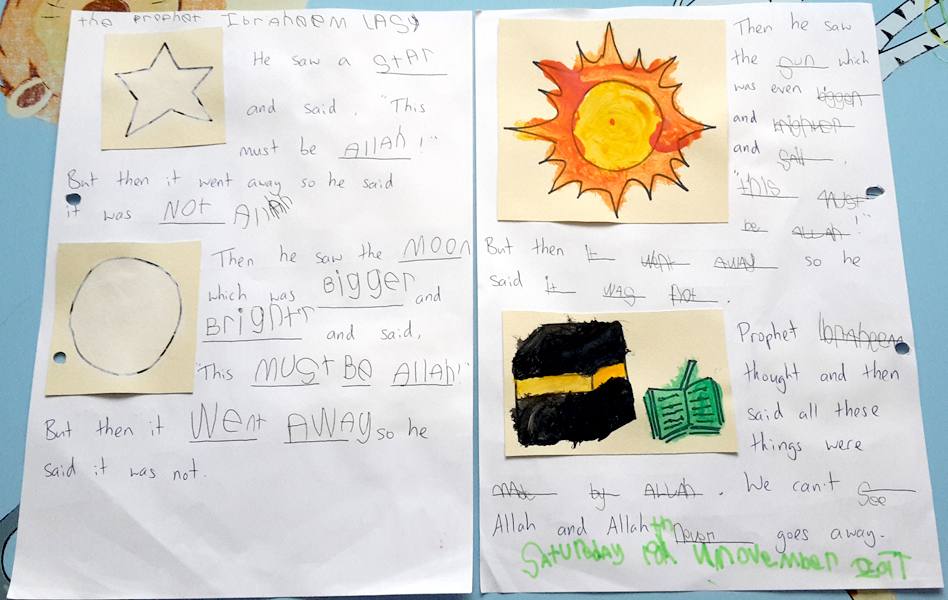
When we finished, I helped them summarise what the story was about: Prophet Ibraheem (AS) looked at the things in the sky (first the stars, then moon, then sun - each thing was bigger and brighter than the one before it!) and he wondered if they were Allah... but he decided they couldn't be because they kept disappearing. He understood they were only made by Allah and that Allah never disappears.

On a piece of card I asked them for ideas to represent each part of the story and drew outlines in black felt tip. Then we got the paints out and they coloured the pictures in.

Once the pictures were dry (we actually did this the next day), they wrote the title on a piece of plain A4 paper and glued the first picture at the top. I wrote some simple sentences next to their picture, saying out loud what I was writing, and leaving blanks for key words.

He saw a _____ and said, "This must be ______!" But then it went away so he said it was _______.

Then they stuck down the next picture (they had to remember what this was rather than me tell them) and we continued in the same pattern, with me writing sentences with gaps for them to fill in. Because the story follows a pattern I challenged them a little by leaving more blanks for each picture.

Then he saw the ____ which was ______ and ______ and said, "This ____ __ ______!" But then it ____ _____ so he said it was not.

Then he saw the ____ which was even _____ and ______ and ____, "____ ____ __ ______!" But then __ ____ ____ so he said __ ___ ___.

We discussed the meaning of the story before they stuck the final picture down and I wrote the last couple of sentences based on their summaries.

Prophet _______ thought and then said all these things were ____ __ ______. We can't ____ Allah and Allah _______ goes away.