Showing posts with label prophets. Show all posts

Thursday, 21 March 2019

Prophet Musa (AS) - 3 - Escaping from Firaun

Over a couple of days, we read from our books the part of the story where Musa (AS) was chased by Firaun, ending up with Firaun drowning in the sea.

We also watched some of this video (played in background while they were downstairs) and then this Adam & Mishmish video to inspire the girls' imagination before their craft, so they could think what the Red Sea at the time might have been like and which kinds of fish they could draw in the water.

For our craft, we made another simple folding pop-up using blue paper, yellow paper, cutting/sticking drawings of fish from scrap paper and using glitter pens for the waves of the sea:


We talked about how Firaun only called out to Allah right at the end as he was drowning - but it was only out of fear and it was too late. The lesson I wanted them to learn was to follow the right path before it's too late - don't get distracted by what's easy or what might look like more fun. And to talk to Allah during good times too, thanking Him for His blessings, not only when times are bad and you need to ask for help.


We also went to Brueton Park, as we've not been before and I've heard good things about it, as a place for them to stand in front of a large body of water... Since we're a little too far from the coast! So they could appreciate a little the feelings of despair Musa (AS) and his people must have felt, knowing they were being chased and with no way across, and then awe from seeing the water part before them.

While we were in the park, we recapped the previous part of the story where Prophet Musa first went to Firaun and the magicians threw down sticks to look like snakes... We found some sticks and I asked the girls to try and arrange them to look like a snake... It wasn't easy! And it definitely didn't look real! But when Allah commanded Musa (AS) to throw down his staff, what happened? It was a miracle and it really did turn into a snake! No wonder the magicians believed in the message, because even though their sticks looked like real snakes (enough to frighten Prophet Musa), they knew they didn't have the power to make them come alive. Only Allah has the power to give life to things.

Wednesday, 13 March 2019

Prophet Musa (AS) - 2 - The burning bush

We read the next part of the story of Musa (AS) from book 1 of the Safar series, this time focusing on the time when Musa (AS) became a prophet. The lessons I wanted to bring out from this were 1) recapping miracles from Allah and 2) how Allah speaks to us through the Quran.

I asked them if they could remember any other miracles we've talked about to do with other prophets... Alhamdulillah, they could! We spoke a bit about them then did a simple craft together to help them remember this part of the story.


For their craft, they made a collage of a bush on fire. I asked them how they wanted to do the bush and M said to paint it... Then they cut up pieces of cellophane (old sweet wrappers!) and used PVA glue to stick them on top as the fire.

When they were done, we spoke some more about how Allah is able to do anything. Allah spoke to the prophets and sent them signs and miracles. But did he speak to them like we speak to each other? No, it was usually through dreams - but he spoke to Musa (AS) directly. And does Allah speak to us? How can we hear Allah's words? By reading the Quran! And the Quran itself is a miracle too... No one can write anything like it - although this is a little more complicated to understand/appreciate until they're older! I thought it still worth mentioning now. 💕

Monday, 4 March 2019

Prophet Musa (AS) - 1 - As a baby

We read the beginning of the story of Prophet Musa (AS) together, from the books which we have, focusing on his mother putting him in the river and how Allah not only kept him safe but also reunited them together - the morals I wanted the girls to understand from this part of the story were 1) to trust in Allah and 2) if Allah wants something to happen, there's nothing anybody can do to stop it from happening.

We talked about how Prophet Musa's mother must have felt when she gave birth to a boy and knew the soldiers would kill him if they found him... We talked about whether it was easy for her to put her baby in the river - because what might happen to him in the river? But what would happen to him if she didn't do it? We related it to baby A (who's now almost 8 months mashaAllah!) and how they would feel having to do that to her - and mothers love their children a lot more than siblings love each other! But where did the idea come from in the first place? It was from Allah so Musa (AS)'s mother trusted it would be ok... And it was!

Since it came up, we had a brief biology lesson into why Firaun's wife needed a nurse for the baby... By "nurse" the book meant "wet nurse" and a wet nurse is a woman who breastfeeds the baby for the mother - maybe the mum can't feed the baby herself for whatever reason (no milk, not enough milk, too busy, doesn't want to!) and in those days they didn't have baby formula and bottles! So why couldn't Firaun's wife feed baby Musa? Because women don't make milk all the time, only after they've had a baby. Firaun's wife hadn't had the baby so that's why she needed a wet nurse for him - and Allah brought Musa (AS)'s mother back to him in this way.

For our craft activity, to help them remember the story, I thought of a simple pop-up type picture - similar to the zamzam picture we did before. I drew my idea on the whiteboard so the twins knew what the end product was supposed to look like:


Then they painted their picture onto white card. We used watercolours again (it feels like watercolours have turned into the art theme for now!) and talked about blending different shades, the direction of their brush strokes (F said they should be horizontal for the river and vertical for the grass!) and how they could layer the paint as it dries.

While the paintings dried, they drew, coloured and cut a picture of a basket from some brown card and sellotaped the back to a blue pipe cleaner. A lolly stick would have been better, but I've still not got round to buying more yet! But this was a good chance to recap materials: we talked about what the problem was (it was too flexible!) and how they could fix it (make it shorter... make it thicker...) - they ended up folding it in half and twisting it about itself which made it a bit more sturdy.

I cut a line along the centre of the river so they could thread their pipe cleaner through and so move the basket by using the pipe cleaner as a handle. Finally, I asked them to write a sentence to summarise what the picture showed.


MashaAllah Z did well, copying her sisters! I think this is the first painting she's done which has actually resembled something and not just a brown mess. 😂


Friday, 22 February 2019

Prophet Eesa (AS) & Miracles

As usual, we began by reading the different versions of Eesa (AS)'s story from the books which we have.

The girls are already a little familiar with Prophet Eesa (AS) as it's been brought up in discussion for the past couple of Christmases (What's Christmas? Who celebrates it? Why?) so this time I wanted to focus on the concept of miracles, using Eesa (AS)'s story as the example.

After reading the stories, I asked the twins what they thought the word "miracle" meant... After some talking, they decided it's "a thing that's not supposed to happen, is amazing and good!" I asked if they could think of any miracles to do with the prophets we'd looked at so far... They came up with Ibraheem (AS) being protected from the fire, Yunus (AS) surviving after being swallowed by a whale, and Adam (AS) being made from clay with no mother or father. 👍 But in Eesa (AS)'s story, there were a lot of miracles mentioned!

For our next session, which was a few days later, I asked them if they could remember any of the miracles to do with Eesa (AS) - the ones which came to mind straightaway for them were making a bird from clay fly as if it were alive, he spoke as a baby, and knowing what was in people's houses without looking. So I told them I wanted some more examples... so what could they do? Look in the books again! As they flicked through the pages, searching for the relevant ones, I told them what they were doing was called research and that I would make notes on the whiteboard as they found more information. After a while, the 8 miracles they came up with were:

- no father
- spoke as a baby
- knew what was in people's houses without looking
- bird from clay came to life
- dead people came back to life
- cured sick people
- made a blind man see again
- table of food sent from heaven

Next, I gave them a piece of white card each and told them to write the word "miracles" in the centre - demonstrating on Z's card. Around the edge, they then needed to choose at least 5 of the miracles on the board and draw a picture to represent each one... When they were done, they could either write what the miracle was themselves or I could do it for them (as I was explaining the task it seemed like they were getting overwhelmed, which is why I offered!) - in the end, they both asked me to do the writing. 😂 Before they started, we talked about the possible pictures they could draw (e.g. a speech bubble for Eesa (AS) speaking as a baby) because they weren't allowed to draw Eesa (AS) himself, or his mother, Maryam (AS)!

Finally, we took the watercolours out again so they could colour everything in. Why watercolours? Because they could thin the paint appropriately in order to paint over the top of the captions but still be able to read them! So they were practising experimenting with the ratio of paint:water and seeing the effect it had during this activity, too. They coloured in the centre bubble first, so it had time to dry as they did the rest of their painting, then I asked them to paint over the writing in a different colour - so this time they needed to make sure their watercolours were less watery to ensure they showed up!


As usual, Z did her own version! I wrote a caption in the corner of her page too, upon her request. 😂


As they worked, we had a little discussion about Prophet Eesa (AS) in Christianity... How he's known by the name Jesus and how Christians believe he's the son of God. Allah is God - can Allah have children? No! So why do Christians believe Jesus is God's son? Because normally, to get a baby inside a woman's tummy, you need a man, a husband to help - like Papa is Mama's husband and your father. But did that happen for Eesa (AS)? No, Maryam (AS) didn't have a husband! Allah just put a baby in her tummy just like that, because He can do anything! But the Christians, they thought if Allah, if God was the one who put baby Eesa (AS), baby Jesus in his mummy's tummy, then that must mean God is the father! So if God is his father and Jesus is God's son, that must mean Jesus is like God too! So Christians pray to Jesus and worship him too. Is that what Muslims believe? Is that what we believe? No! Eesa (AS) doesn't have a father; that's just one of Allah's miracles. And he's not Allah's son! But he is special because he's one of Allah’s prophets. Can we worship anyone or anything other than Allah? No!

As we spoke, I helped by drawing a simple diagram on the whiteboard, similar to the bottom branches of a family tree: crossing out the dad and writing Allah’s name as part of the tree when talking about Christianity, and crossing out the dad completely and writing Allah’s name separate when talking about Islam. We also briefly talked about people who are neither Christians nor Muslims and they don't believe in Eesa (AS) or Jesus at all - they think Maryam (AS) had a baby with a man who wasn't her husband and Eesa (AS) isn't special at all! But we know that's wrong because? Allah put Eesa (AS) in her tummy and Eesa (AS) is special because he's one of our prophets. 💕

Friday, 1 February 2019

Prophet Yunus (AS) & Making Mistakes

We read through the story of the Prophet Yunus (AS) from the books we have at home, talking about it as we went along. When we were done, I asked them to try and summarise the story back to me, so I could check their understanding.

As we're still working on our growth mindsets at the moment, I decided to use Yunus (AS)'s example as a way to highlight the moral of making mistakes then going on to fix them... Making a mistake isn't the end of the world. If we make a mistake, we should just try our best to fix it, however we can. Allah (SWT) is the only one who never makes mistakes and He is always there to listen to us when we need help. We can always make dua to Allah whenever we're in trouble or we need help... What was the mistake Yunus (AS) made? He left the people before Allah said he should stop delivering his message... How did he fix his mistake? He admitted he was wrong and asked Allah for forgiveness, by making dua.

Finally, we made a simple craft to make the story and moral more memorable... Because we can't draw the Prophet Yunus (AS), what would be a good picture to remind you of the story? A whale! 🐋 I decided to link this to their current work in Science on properties of materials by having them make a sun catcher. We didn't have any tissue paper to hand, so we improvised using tracing paper and felt tips! And, with help, this was an activity the toddler could join in with too.


I printed out the outline of a whale (to fit onto an A5 piece of paper) for them to trace onto tracing paper, which I'd pre-cut to A5 size. Then they chose a piece of A4 coloured card each and folded it in half. In the centre, they drew a circle by drawing around a bowl. While they were colouring their whales in using felt tips, I cut this circle out for them. Then, as if their card were like a book, they glued their tracing paper in between so the whale lined up with the cut out circle. Finally, I helped them cut around the edges so the card became a frame.

After I'd blutacked their sun catchers to their bedroom window, I asked them if they thought the tracing paper part of their sun catcher was transparent or opaque... M said transparent and F said opaque! Fortunately for me lol. So I explained the tracing paper is kind of in between: it blocks some light but lets some light through, so we can kind of see through it but not really - and the word for this is "translucent". Which part of the sun catcher was definitely opaque? They both said the card frame. And can you see anything in the window which is definitely transparent? They both said the glass of the window. I then pointed to each part in turn for them to describe as either transparent, translucent or opaque.


Later on, when we went downstairs and they were playing with their tracks, M asked if the box was transparent or translucent... Because it was see through but it wasn't clear, it was purple! After some talk, we decided that it was both - because the ridges on the lid were a bit cloudy to make them translucent while the rest of the box was transparent even though it was tinted a colour. 😄

Sunday, 30 December 2018

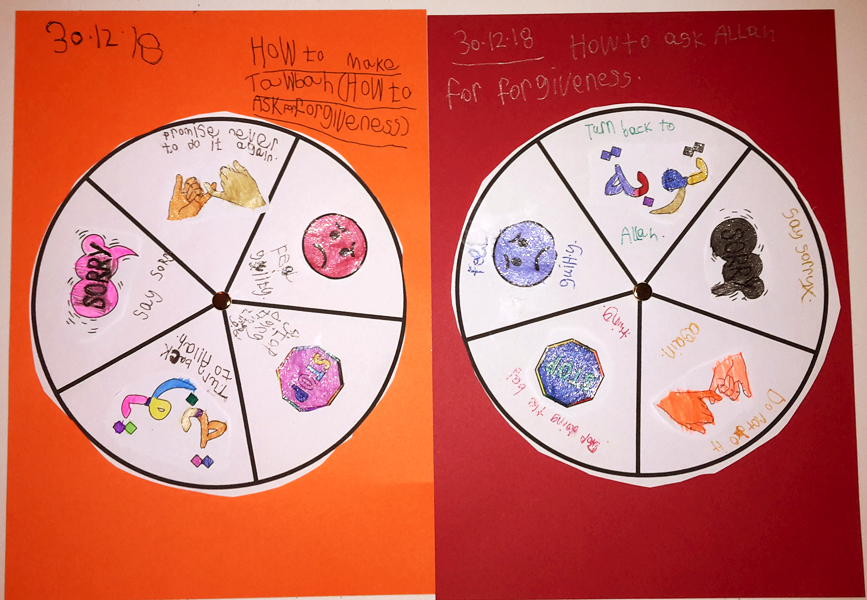
What is tawbah?

I had this idea since learning about Prophet Adam (AS) in more detail, but I didn't get round to doing it due to being busy with the new baby etc. So now we've looked at Prophet Nuh (AS), I decided to link this lesson in with his story instead, then refer back to Adam (AS) as a kind of revision.

So we verbally recapped the story of Prophet Adam (AS), focusing on the part where Adam (AS) and Hawwa (RA) ate from the tree. They immediately felt ashamed and wanted to ask Allah to forgive them - so they made tawbah. Then we talked about Nuh (AS) calling to his people - what did he say to them? They were making a mistake by praying to idols; they needed to make tawbah and turn back to Allah. So what did "make tawbah" mean...? The girls said they thought it meant to say sorry for doing a bad thing.

The next day, I gave them a worksheet to turn into a simple spinning craft.


You can download our worksheet here.

We read through the simple explanation together, then they coloured in the 5 pictures which represented each step of how to make tawbah. They decided to use their glitter gel pens because they wanted to make it look special and "Islam is special". 😁

Then they cut out the pictures along with the circle template, stuck the pictures one per segment and wrote a few words with each to explain what the step was. Finally, we pushed a split pin through the centre to attach it to a piece of A4 card and they wrote the date and title on the card. ✌

Saturday, 15 December 2018

How did the Prophet Nuh (AS) show sabr?


We reread the story of Prophet Nuh (AS) using the book Safar Islamic Studies -Textbook 2 and talked about the meaning of the word sabr as being patient: waiting for something to happen without getting cross/upset and putting trust in Allah when something bad/we don't like happens.

I asked the girls if they could think of any examples of when Nuh (AS) was patient and showed sabr... They came up with how he told the people about Allah for 950 years, even though they were rude to him, and how he must have felt when his son drowned.

I gave the girls the pictures from the worksheet and asked them which part of the story they thought each represented (reminding them how and why we can't draw pictures of the prophets themselves or their companions out of respect!) as points where Nuh (AS) was patient. The two pictures they didn't think of themselves were the building of the ark, with people laughing at Nuh (AS), and waiting for 40 days and nights on the ark for the rain to stop.

Then they cut the 4 pictures out and arranged them in chronological order to stick down on the second part of the worksheet.

Finally, they wrote a small caption under each picture, to explain what it showed, and coloured the sheet in.

You can download the worksheet here.

Tuesday, 27 November 2018

Who was the Prophet Nuh (AS)?

We read through several different versions of the story of Prophet Nuh (AS) from the different books we have at home, and discussed it along the way:


When we were done, I asked the girls how do we know this story? How do we know this happened to Nuh (AS)? After some prompting and discussion, the girls came upon the answer that Allah talks about Nuh (AS) in the Quran. I took out the English translation to find an example of where Allah speaks about the Prophet Nuh (AS) - after looking through the contents of all the surahs, Surah Nuh seemed like a good one to read through! The English was a little difficult for them to understand all the words, but they understood enough to see it was part of the story we'd just read. I explained that the rest of Prophet Nuh (AS)'s story is in different surahs in the Quran, not all in one place like in the books we'd just looked at.

----------

We were gifted some small toy animals from my parents when the twins were younger, and because they used to fight a lot over the same toy at that age it meant we have pairs of animals to play with. 😂😂 So we used these to practise our 2x table in the context of counting the animals walking onto the ark, and sang the song, "The Animals Went In Two By Two" (Hurrah! Hurrah!) as we played with them. 😁😁

We also had a conversation about why two animals were chosen, why not more (because there would be no space!) and why not less (because you need two to make more!). And about how a male and female animal (including humans as well as other living things such as plants) are needed to make a baby. We didn't go into the details of reproduction! Just that you need a male and a female pair. M noted that it wouldn't make sense to have two male animals or two female animals going on the ark, they must have been one of each. Then I gave them a quick explanation of how by starting with just two animals, they were able to keep multiplying to get lots and lots more after some time - so even though Nuh (AS) couldn't take e.g. all the elephants with him, by taking just two elephants it made sure that all the elephants didn't disappear completely (or become extinct) after the flood.

----------

After a couple of days, we revisited the story and I asked the girls to summarise it for me - which they were able to do, MashaAllah. Then I told them they were going to have a go at making their own boat. What did Prophet Nuh (AS) use to build the ark? Wood! So we were going to use wooden lolly sticks to make ours as a mini version. We were also going to use PVA glue to stick our pieces together... but do they think Prophet Nuh (AS) used glue? No! He used a hammer and nails.., But we were just going to use glue since we're just making a model.

I gave them all the lolly sticks we had left in our craft supplies, some PVA glue and a couple of brushes to spread it with. Then told them to work together to make a boat and we could test it in the bathtub later, inshaAllah!

This is the first open ended creative building kind of task I'd set the girls, so I was interested to see what they'd do... It was great to see them discuss ideas, try something out, evaluate as they went along, make mistakes and change their plans... I tried my best not to give them any input from myself but used comments and questions such as, "What are you going to do next?", "Did that work the way you wanted it to?", "It keeps falling down. Why do you think that is?", "How could you make it stronger?", etc.

They began by making a "floor" by gluing a row of lolly sticks together. It kept sliding apart so one had the idea of putting a stick perpendicular underneath to keep them in place, which then became a stick glued on top perpendicular to the rest and they glued some more in the original line to complete the length. They were still sliding up and down a bit, so the girls decided to glue another perpendicular stick on top at the other end - then decided to just fill in in between and have another long row of sticks on top but perpendicular to the ones underneath. They were happy this gave a solid structure so now wanted to put some "walls" on their boat. First, they tried gluing a stick on its edge, which took several attempts to get to stand straight. Then they tried gluing another on top to make their wall taller, but no matter how they tried it wouldn't balance right. So they decided to keep the wall only one stick high and make an identical wall on the other side. Then they wanted to put a "roof" on the boat by gluing a stick on top of the two walls to join them together - but the weight of the stick on top made their walls fall down. So they came up with the idea of making their walls thicker and, because they wanted them identical, made both walls three lolly sticks wide. They only had two sticks left now so glued them both across as the roof.

I think if we had more sticks they would have happily kept going! I was really pleased to see them so engaged and determined even when it was tricky to get the sticks to stay in place and the structure didn't work out the way they wanted it to. 💕


We left their boat to dry overnight (why? because the glue was still wet so if we tried to put it in the bathtub now it would just fall apart!) then took it in the bathroom to test.

We talked about the story of Prophet Nuh (AS) again and the girls remembered that it wasn't raining at all when he built the ark, so there was no way Nuh (AS) could test it would work! He just had to trust in Allah, which he did. So we put their boat into the bathtub without any water.


Then the rain came (turn the shower on!) which didn't stop for 40 days and 40 nights! The girls were excited to see their little boat float up on the water as it rose (I purposefully aimed the showerhead to the side of the bath rather than on top of their boat!) and watched it spin and float this way and that. Was there any way of controlling which direction the boat was going? No, it was just being carried away with the water, just like the ark was with Nuh (AS) on it. We turned the shower off and watched the boat float for a while. What happened next in the story, after the rain stopped? The girls said the water all went away and then Nuh (AS) and all the animals could come off again. So we drained all the water away from the tub.

I asked if the girls wanted to do it again but this time with animals on their boat? Of course, the answer was yes! So we put a pair of animals on the boat and turned the shower on again. There was only room on their boat for one pair of animals - we talked some more about how large the ark must have been to fit in a pair of every animal, plus Nuh (AS) and all the believers! We tried squeezing another pair of animals on but their boat sunk and the other animals fell off... much to their amusement. 😂

Finally, we drained all the water away and retold how the ark stopped on top of a mountain for Nuh (AS) and the believers to finally disembark. By this point the glue on our boat was starting to get washed away and the sticks come apart, so we talked some more about the materials Nuh (AS) used to make the ark and what we could do next time if we wanted to make our lolly stick boat last longer!

Saturday, 15 September 2018

The story of Prophet Adam (AS)

The girls are already familiar with the Prophet Adam (AS) from their children books, but I just wanted to go through it myself to make sure they understood that being sent to Earth was NOT a punishment - unlike what Christians believe - as is told in the Quran how Allah told the angels He was going to create people and put them on Earth. I also wanted to make sure they were able to recall the main parts of the story themselves from memory.

I wrote the story in language suitable for 4-5 year olds, while still retaining as much meaning/original translations from the Quran as possible, after making notes from a variety of sources (including Tafsir Ibn Kathir and lectures from speakers such as Mufti Menk and Nouman Ali Khan).

PROPHET ADAM (AS)

A long, long time ago, Allah created the world. He created the sun, the moon and the stars. He created the seas and the mountains. He created the trees and the flowers. He created the fish, the birds and the animals. Allah created everything.

Up, up, high above the sky in the heavens are the gardens of paradise: Jannah. In Jannah you never feel hungry, thirsty or tired. You have no reason to feel pain or sadness. In Jannah, Allah spoke to the angels. He told them He was going to create humans and put them on Earth to live and look after it. The angels praised Allah day and night; they always obeyed Allah but they didn’t understand why Allah wanted to make humans. The angels were worried humans would fight with each other and spoil the Earth. The angels worshipped Allah so much they didn’t understand why people were needed to worship Allah too! But Allah simply said to them, “I know what you do not know.”

Allah created the first man, Adam, from a handful of clay gathered from all the Earth: this is why humankind is all different colours and with all different personalities, just as the mud from around the world is different. Some people are kind and generous, some are selfish and mean, some are in between. Some are evil, some are good and some are in between.

Allah created Adam with his hands and blew his soul into him. When the life entered Adam’s head, he sneezed and the angels told Adam to say, “Alhamdulillah.” When he did, Allah replied, “Yarhamukhallah.” This is what we should say when we sneeze and reply when someone else sneezes.

When Adam was sent to greet a group of angels, he said to them, “As salaamu ‘alaikum,” and the angels replied to Adam, “Wa ‘alaikum as salaamu wa rahmatullah.” This is the way we should greet and reply to people we meet.

Allah taught Adam the names of all kinds of things, such as trees, mountains, the sea, camel. Allah showed these things to the angels and asked them to name them, but the angels could not. They said to Allah, “We only know what you have taught us.” Allah then told Adam to tell the angels the names of all the things. When Adam finished, Allah said to the angels, “Did I not tell you I know the secrets of the heavens and the earth, and I know what you show and what you hide?”

Amongst the angels, there was one Jinn who had been raised to a special rank in the heavens. His name was Iblis. When Allah told the angels to bow down to Adam, they all obeyed except for Iblis.

Iblis was too proud and arrogant. He said to Allah, “Why should I bow down to him when I’m better than him? You made me from fire and him just from clay!”

Allah said to Iblis, “Then get out from here. You are rejected and cursed. The curse shall be upon you until the Day of Judgement.” Allah threw Iblis out from the gardens of Jannah.

Iblis said to Allah, “If you let me go until the Day of Judgement, then I will lead his children to the wrong path – all of them but a few!” Allah let Iblis go and told him that any people who follow Iblis’ evil whispers will be sent to the hellfire… But Allah also told him that Muslims who worship Allah and do good things can never be led wrong by Iblis.

Prophet Adam was sent to live in Jannah but because he was the only human he began to feel lonely. While Adam was sleeping, Allah created the first woman, Hawwa (or Eve) from Adam’s rib. When Adam woke up he was surprised to see her sitting beside him, but he was also happy to have another person for company.

Allah told Adam and Hawwa they could eat and enjoy anything they wanted from the gardens of paradise - all except from the fruit from one particular tree. If they ate the fruit from that tree, Allah warned something bad would happen to them.

Allah told them that Iblis was Adam and Hawwa’s enemy. Iblis didn’t want Adam and Hawwa to stay in Jannah. In Jannah, you will never feel hungry or thirsty, too hot or too cold. Iblis was jealous of Adam and Hawwa.

Iblis whispered lies to Adam and Hawwa, to trick them into eating the forbidden fruit from the tree. Iblis told them he was their friend. He lied and said, “If you eat from the tree, you can become angels and live forever.”

Adam and Hawwa ate from the tree. As soon as they did, they felt ashamed and naked. They quickly hid themselves behind fig leaves to cover their shame.

Allah asked Adam and Hawwa, “Didn’t I tell you not to eat from the tree and that Shaytaan is your enemy?” Adam and Hawwa admitted their mistake and asked Allah for forgiveness. They made tawbah. Allah is most merciful and kind.

Allah sent Adam and Hawwa down to live on Earth, along with Iblis. Iblis wants to lead us away from remembering Allah, but Allah has promised us if we worship Him and do good deeds then one day we will be able to return to Jannah.

You can download the above story as a MS Word file here.

After reading the story to the girls (in an interactive way, asking questions and letting them ask questions), I asked them what they thought the main points were - just what they could remember regardless of where it came. I wrote these as a spider diagram on A4 coloured paper. Once they had them all, with some prompting, I asked the girls to put the points in chronological order by numbering each one.

***find photo***

I then gave them a storyboard with the story summarised into six sections and told them that a summary is when we don't give the whole story, or every single bit of information, but just tell the most important points - like how they summarised it in the spider diagram. We read through the storyboard together, then I asked them what they thought might go in the big empty boxes? Pictures! But are there some things we aren't allowed to draw? Can we draw Allah, or the angels, or Shaytaan or Adam (AS) and Hawwa (RA)? So we talked about what they could draw in each box which wasn't any of those things, e.g. Allah's creations, clay, fire to represent jinn, gardens, a tree, Earth.


Finally, I asked them if they thought the story needed a little bit more detail - then we worked through each box in turn so they could add something extra, using the notes from the spider diagram to help. I decided to let them try spelling everything themselves then showed them any corrections once they'd done.

MashaAllah, I was pleased they clearly understood that being sent to Earth was planned from the beginning, in one of the twins' words: "It wasn't a punishment because Allah already said He was going to put them on Earth even before he made Prophet Adam! And they said sorry!" 💕

We did this whole lesson over a couple of days.

You can download our storyboard template here.

Friday, 27 April 2018

The Holy Books in Islam

Our next article was the holy books, so understanding Allah sent revelation/divine scriptures to some of His prophets and being able to name the four mentioned in the Quran. If they could remember which book was sent to which prophet, that would be a bonus at this stage!


First, we recapped who the prophets were, i.e. messengers from Allah to teach people how to behave, guide them away from wrong and towards good deeds instead. I asked them to name me a couple of prophets then I explained to them that there are two different Arabic words for the prophets in Islam:

Nabi (نَبِي) = prophet
Rasool (رَسُول) = messenger

So all the prophets are nabi but only some of them are rasool... I didn't expect them to remember this at this age, it was just a precursor to the point: so Muhammad (SAW) was both a nabi and a rasool. He was a nabi because he's a prophet and he's a rasool because he was given which book as a message? The Quran!

There are 3 other holy books mentioned in the Quran: the tawraat, the zabur and the injeel; these were given to the prophets Musa (AS), Dawud (AS) and 'Eesa (AS) respectively. So were these three prophets rasool as well? Yes!

The activity was a simple cut, stick and colour to consolidate this new information.

You can download the worksheet here.

Friday, 20 April 2018

Who Were the Prophets?

For our second article of faith, we looked at belief in the prophets.

We started by recapping the difference between the pillars of Islam (things to do) and the articles of faith (things to believe in) then I got them to recite the shahadah and give a rough translation: "I believe in Allah" (which we did last time as our first article of faith) "and Muhammad (SAW) is his messenger."

But what is a messenger?

We talked about it in everyday terms first, i.e. the person who delivers a message/news/etc. to someone else, using examples they could relate to (e.g. Mama sending one of them as a messenger to tell Papa to wake up!) Then we talked about it in terms of religion, defining it simply as someone Allah sent to tell people not to do bad things and to teach them how to do good things instead. As we've covered Prophet Ibraheem (AS)'s story in detail already, we used him as an example - what were the people doing before he was sent? Praying to idols. What was Prophet Ibraheem (AS) sent to tell them? To pray to Allah instead.

We then talked about other prophets they knew, e.g. from stories I'd told or read to them (we used to read from My First Quran Storybook as bedtime stories when they were 3-4 years old, paraphrased where needed) or they'd heard mentioned in the Quran... and briefly recapped one or two points about each one, e.g. Prophet Yunus was swallowed by a whale; Prophet Adam was the first man and was tricked by Shaytaan into eating from the tree, etc.

I asked them if we were allowed to draw pictures of the prophets and why not? They said no because it was rude - we didn't know what they looked like and we might draw them wrong. 💕


Finally, I showed them the worksheet and we read through it together, with me pausing at the blanks for them to give ideas of what should go there. They were amazed when they heard Allah sent thousands of prophets to mankind! I told them only 25 are mentioned by name in the Quran and we would insha'Allah learn about those ones one at a time, just as we learnt about Prophet Ibraheem (AS). I also checked they knew that no more prophets were going to be sent to us because Allah has already sent His final messenger - and that they knew this was Muhammad (SAW)!

We went through the picture clues together too, with them guessing which prophet's name should go where, then I left them to colour and fill in the sheet themselves. They just wanted help with spelling the prophets' names when they got to that part. 👍 They also noticed that they wrote (AS) after all the prophets' names except for Muhammad (SAW) so we talked about why that was too.

You can download the worksheet here.

Sunday, 8 April 2018

Prophet Ibraheem (AS) - 07 - Building the Ka'bah

This is the last part of Prophet Ibraheem (AS)'s story I wanted to cover in the Reception year: how he and his son, Ismail (AS), built the ka'bah.

We read pages 40-44 together in the Migo & Ali book followed by pages 125-127 in the My First Quran Storybook, discussing the story as we went along.

I decided to do a few activities relating to this part of the story.

First, we reminded ourselves of which 3D solid the ka'bah is, i.e. a cube, and what the properties of a cube were: 6 square sides/faces all the same (thinking about other examples of cubes around the house, e.g. dice, boxes, to help). Then we talked about how we could build a model of the ka'bah using our Duplo blocks. Which blocks would we need? Which part did Prophet Ibraheem and Prophet Ismail build first? What shape would the base need to be? How tall should we make our model? How could we make the roof? I watched them work together to build their cube, prompting with questions along the way.


When they'd finished, I showed them some photos of the ka'bah and how its outside sometimes looks different, i.e. the design of the covering and how the cloth is sometimes lifted up, but in all the pictures the ka'bah is the same cube shape. I also pointed out where the black stone (hajar al-aswad) is situated, on the Eastern corner next to the door, and where the Station of Ibraheem (Maqam-e-Ibraheem) is, i.e. the stone Prophet Ibraheem (AS) stood on to build the upper walls. They remembered our recent Umrah trip and mashaAllah could link the experience with our lesson. 💕

I found all the images on Google, but you can download the pictures we used here.

I asked them how we could make our model look more like the real ka'bah and we talked about the covering being made from cloth... So we used a small black cloth to cover our model. (While I went upstairs to find some, I gave them the task of adding the Maqam-e-Ibraheem to their model; what colour/size/shape block could they use and where should it go?) After draping the black cloth on top they said it was still missing something: gold decorations! So we tied some gold ribbon across the top. We'll leave this model ka'bah for a few days for them (and their younger sister!) to include in their imaginative play - until they want to build something else. 😂


The other activity I did with them was to introduce the idea of 3D solids being built from 2D nets. I found an old cardboard box (food packaging is good for this) and asked them what shape it was: a cuboid/rectangular prism. Was it 3D? Yes! Then I showed them how to carefully open it out flat. Was it still 3D? No! How many faces does a cuboid have? Can you see the six different faces? Two smaller rectangles, two medium rectangles and two larger rectangles? I highlighted the pairs of faces in different colours and showed them how to fold it back into a cuboid again, then explained that we could do the same thing for a cube and this 2D pattern is called a "net".


I asked them how many faces a cube had and what 2D shape they were, so what might they expect the net of a cube to look like? Then I gave them a pre-drawn net of a cube each to cut out. I decided not to include the flaps at this age as I thought they might complicate things/be too fiddly for them. We talked about which lines they needed to cut across (not all of them!) then I highlighted the edges as a guide.


Once they'd cut the net out I helped them crease along the lines then asked them to try and fold it into a cube...


We compared our paper cubes with the cuboid from earlier... Which was stronger? Why? How could we make our cube stronger and how could we make it look like the ka'bah? After some discussion they decided they needed some black card. 💪 (This was our Science link and thinking about different materials 😀)

They stuck their paper templates (new vocab!) onto the black card and cut their net out again. I helped them fold the edges again, then we used sellotape to stick the sides together and decorated our models with strips of gold paper.


You can download our net of a cube here.

I was going to leave it there, but they wanted to put something in their folders... 😂 So I printed out a couple of the photos so they could summarise that part of the story and what they did!


You can download our worksheet as a template here.

Sunday, 25 March 2018

Prophet Ibraheem (AS) - 06 - The Sacrifice


We read about Prophet Ibraheem (AS) being told to sacrifice his son (this time we used My First Quran Storybook, pages 114-117, as this part of the story isn't included in the Migo & Ali book we've been using so far) and discussed the story along the way, including how Prophet Ibraheem (AS) and Ismail (AS) believed in Allah so much and how they weren't afraid - comparing to how the twins might feel in the same situation!

As a simple reminder, I found a clipart of a ram online and printed it out for the girls to colour and glue pieces of wool onto, after sticking onto their choice of coloured A4 card. Even the toddler joined in! Then they both wrote a sentence to summarise what they had learnt.

Monday, 19 March 2018

Prophet Ibraheem (AS) - 05 - Ismaeel (AS) and the Zamzam


For this part of the story, we read pages 37 to the top of page 40 in the Migo & Ali book - covering when Prophet Ibraheem (AS) left his wife and baby son in the desert and how the well of zamzam water was found. Again, this was something they were already a little familiar with through previous work, stories and discussions to do with Hajj and Umrah - but to keep with the chronological order of the topic I felt there was no harm in revisiting it.

To recap what happened, we made a simple pop-up craft using A4 card. I prepared the pieces in advance: a horizontal piece of yellow A4 card with a 75mm tall strip glued at the edges a little up from the bottom, the outline of a fountain (about 50mm tall) cut out from blue card, the outlines of hills cut out from brown paper, 2 coloured lolly sticks (I didn't have blue or would have used those!). If your children are more artistically inclined than mine, you may like to let them create these parts themselves!

On the first day, the twins painted the bottom part of the card as well as the strip going across brown (cue revision of which colours from our paints mixed to make brown and demonstration of how changing the ratio of red/yellow/green changes the hue - though by the time they were done it was all one shade of brown anyway 😂) - to represent the desert sand. I would have liked to use sandpaper or craft sand, but we didn't have any to hand so insha'Allah next time! They also coloured in the zamzam water using blue glitter glue pens. We talked about what happened in the story as they worked, then left everything to dry overnight.

The next day, they glued the hills down (recap what Prophet Ibraheem's wife had to do and why, so where did they think they should place the hills on their paper?) and sellotaped the zamzam water to the top of the lolly stick.

Asked them to tell me where the zamzam spring came from and how - then I showed them how to thread the lolly stick under the strip going across so it could move up and down. I then helped them put a strip of sellotape either side of the lolly stick at the bottom of the strip of card, so the stick wouldn't move side to side.

Finally, I asked them what the two hills were called and the twins labelled them with their names.

Tuesday, 6 February 2018

Prophet Ibraheem (AS) - 04 - In the Fire


Before continuing with the story of Prophet Ibraheem (AS), I read the story of Frances the Firefly to the twins (a story I remember from my own childhood! Though that was linked with fireworks and Bonfire Night 😅) and we talked about the dangers of fire and how horrible it would be if our homes burnt down or we were trapped in a fire. Then I lit a match for them to see - with VERY (!!!) careful supervision they didn't actually touch the flame, they put their finger close enough to feel its heat.

Later, we read the next part in the Migo & Ali book (pages 30-36) and discussed it as we went along: what they thought about what happened, how it made them feel, etc. They related it to our previous discussions from reading about Frances the Firefly and looking at the match.

Then I gave them a worksheet each to fill in the gaps (they took it in turns to read each sentence and we talked about what could go in the blank - then they each wrote their own version of the answer) and the option to colour in the fire at the bottom. You'll notice it didn't matter if their fire looked realistic or not, it's more to do with the process to aid with their memory of the story. 😂

You can download the worksheet template here.

Wednesday, 24 January 2018

Prophet Ibraheem (AS) - 03 - Breaking the Idols


We continued reading about Prophet Ibraheem (AS) in the Migo & Ali book (pages 28-29) and discussed it as we went along. We stopped at the part just before the people decide to throw Prophet Ibraheem (AS) into the fire.

I drew an axe onto a piece of plain paper, one for each girl. I told them the handle was made from wood and the head from either stone or metal, so what colours do they think we needed? They decided brown for the handle and grey for the head. We ripped up some brown paper into small pieces then I asked them if they could think of a good material for the head... After some prompting they came up with kitchen foil because it was shiny like metal. 😀 Then we ripped some tin foil into small pieces too.

I demonstrated how they could "colour in" the axe using our ripped pieces of paper and foil and told them this kind of art is called a collage. They used PVA glue (a little watered down) and brushes to stick everything on and to paint a thin layer of glue over the top. They were a bit worried about putting white glue on top but I told them it would dry clear and shiny. 😂

When everything was dry I cut the axes out and they did a bit of role play, pretending to chop things down with their axes! Then we stuck them onto A4 card and they wrote a short summary of that part of the story.

For this exercise I told them to spell the words as best as they could, rather than me dictating correct spellings. I quite like this one's spelling of "idol". 😂

Saturday, 18 November 2017

Prophet Ibraheem (AS) - 02 - Who is Allah (SWT)?


We read pages 26-27 about Prophet Ibraheem (AS) in the Migo & Ali book, discussing it together as we went along.

When we finished, I helped them summarise what the story was about: Prophet Ibraheem (AS) looked at the things in the sky (first the stars, then moon, then sun - each thing was bigger and brighter than the one before it!) and he wondered if they were Allah... but he decided they couldn't be because they kept disappearing. He understood they were only made by Allah and that Allah never disappears.

On a piece of card I asked them for ideas to represent each part of the story and drew outlines in black felt tip. Then we got the paints out and they coloured the pictures in.

Once the pictures were dry (we actually did this the next day), they wrote the title on a piece of plain A4 paper and glued the first picture at the top. I wrote some simple sentences next to their picture, saying out loud what I was writing, and leaving blanks for key words.

He saw a _____ and said, "This must be ______!" But then it went away so he said it was _______.

Then they stuck down the next picture (they had to remember what this was rather than me tell them) and we continued in the same pattern, with me writing sentences with gaps for them to fill in. Because the story follows a pattern I challenged them a little by leaving more blanks for each picture.

Then he saw the ____ which was ______ and ______ and said, "This ____ __ ______!" But then it ____ _____ so he said it was not.

Then he saw the ____ which was even _____ and ______ and ____, "____ ____ __ ______!" But then __ ____ ____ so he said __ ___ ___.

We discussed the meaning of the story before they stuck the final picture down and I wrote the last couple of sentences based on their summaries.

Prophet _______ thought and then said all these things were ____ __ ______. We can't ____ Allah and Allah _______ goes away.

Thursday, 2 November 2017

Prophet Ibraheem (AS) - 01 - What are idols?

The girls were already aware of the Prophet Ibraheem (AS) from some of their story books and our discussions and activities about Hajj (he's mentioned in the 5 Pillars song I wrote earlier!) but I wanted to go through his story in a little more depth as part of their Reception targets. I decided to start with Prophet Ibraheem (AS) rather than Prophet Adam (AS) for the very reason they were already a little familiar with him.

We read the beginning of the chapter about Prophet Ibraheem (AS) in the Migo & Ali book (pages 23-25). This part of the story introduces who he is as a prophet and explains the people at the time used to pray to idols.


As the concept of idols was new to the girls, I decided to use this as an opportunity to make and play with play dough: after incorporating numeracy skills (measuring, counting, etc.) into making the dough they could then play with it (making shapes and rolling it out etc. NOT with the intention of making idols!!) and after a while we could discuss the idea of praying to something we've made with our own hands - of course, the idea of it doesn't make sense to us. Allah made us and made everything... We can't even imagine what He looks like! So making and worshiping idols as gods is surely wrong. After a little discussion the girls continued playing, probably for nearly an hour in total! So the point was subtly mentioned while they were having fun rather than laboured over.

I used the playdough recipe from The Imagination Tree. We found we needed to add a touch more flour than stated, but otherwise the dough is perfect and keeps really well.