After revising partitioning, we recapped how to add 2-digit numbers mentally, i.e. partition into Tens and Units, add the Tens, add the Units, add both parts together. They also had the option of adding the Tens from one number to the other, then counting up the remaining Units, e.g.
28 + 43 =
20 + 40 = 60
8 + 3 = 11
60 + 11 =
60 + 10 = 70
0 + 1 = 1
70 + 1 = 71 so 28 + 43 = 71
OR
28 + 40 = 68
68 + 3 = 71 so 28 + 43 = 71
We concentrated on the first method first, to get them used to partitioning the numbers. Then we moved onto the second method as something more efficient.
After the mental practise, I introduced the column method to them as an efficient way of writing their working out down. It's the same principle, partitioning and adding each place value one at a time, but written in a compact way, e.g.
16 + 43 =
16
+ 43
59
We started with numbers which didn't carry over into the next column, then once they were comfortable with the method I explained how to write the extra Tens underneath the Tens column - and to make sure they included them in their answer! e.g.
45 + 36 =
45
+ 36
81
1
We also spoke about using a quick mental method to check their answers.
We did all the above through explanation and examples on the whiteboard first, then answering questions from a photocopied worksheet using the method we were focusing on at the time.
----------
Next, we recapped subtraction of 2-digit numbers via partitioning and counting down, e.g.
38 - 14 =
38 - 10 = 28
28 - 4 = 24 so 38 - 14 = 24
Where the numbers stayed within the Tens, then using numbers in the Unit column which meant counting down across Tens, e.g.
52 - 26 =
52 - 20 = 32
32 - 6 = 26 so 52 - 26 = 26
After some practise doing this mentally, I then introduced the column method to them - but for numbers which wouldn't require carrying, e.g.
88 - 43 =
88
- 43
45
I decided that was enough for now, so they could get used to the method, and we would look at carrying from the Tens column at a later point inshaAllah!
The above was all done, one method at a time on separate days, first on the whiteboard and then in the context of numbers by working through practise pages from one of the workbooks we have.
Finally, I gave them some word problems to work through so they could use these skills in the context of money. They had the choice to use either a mental or a written method, whichever they found easier.
Showing posts with label mental maths. Show all posts
Showing posts with label mental maths. Show all posts
Friday, 29 March 2019

Friday, 22 February 2019
Maths Update: Times Tables (2x, 5x, 10x)
We've been focusing on multiplication and the times tables facts for the past couple of weeks. The NC for Year 1 introduces the 10x, 5x and 2x tables, which the girls are familiar with now, and the NC for Year 2 mentions them again - so I wanted to concentrate on quicker recall to help with their mental maths.
We began by recapping multiplication theory i.e. What does 2 x 5 mean? It means counting the number 2 five times. This is the same as 5 x 2, counting the number 5 two times - all demonstrated physically with cubes first then as dots on the whiteboard.
Over the week they then did a mixture of worksheets, oral questions, online games (we've signed up to education.com as someone organised a cheap HE lifetime deal!) and simply chanting both as facts (2 x 1 is 2, 2 x 2 is 4, etc) and as sequences (2, 4, 6, 8, etc) forwards and backwards as and when fit with our schedule - to give them plenty of practise and repetition in a variety of ways.
These were mainly to do with the 2x and 5x tables since, after a quick verbal quiz, they showed they understood the pattern for multiplying by 10, i.e. the number becomes 1 place value bigger - an easy trick being to put a 0 at the end (language is important here! I made sure not to say "add a zero", since mathematically adding 0 to a number means it stays the same! And I emphasised it's the place value which changes, which is an important building block for when they move onto decimal numbers in the future inshaAllah). They're able to recall/work out the 10x table up to 10 x 12, as well as calculate random whole numbers x 10, e.g. 24 x 10 = 240, 523 x 10 = 5230, etc. at a good speed, mashaAllah.

I printed out a multiplication square each for them each, up to 12 x 12, which I'm planning for them to keep until they memorise all their times tables... So a few years inshaAllah! I glued the square into a piece of coloured card, to help it last longer, and so there's also space to keep a log of which times tables are tested when. When they're able to quickly recall a multiplication fact, they can colour the corresponding square in - so the goal is to have the whole sheet coloured in. By quickly, the aim is for them to have memorised the fact rather than count it out each time, so I guess under 3 seconds? Instantly, ideally! But they're still young so inshaAllah with more repetition over the years, the speed of recall will only increase. (The girls asked me if I knew my times tables to which I said yes... When did I start learning them? Probably at around their age and I remember having a sheet like them at school to colour in too! So how long did it take for me to finish colouring them all in? I suppose around Year 3 or 4? So around 7 or 8? To which they both laughed because why did it take me 3 years just to learn this tiny square of numbers? F then said she'd definitely finish it all before she was 7. Lol. 😂)
You can download the multiplication square we used here, though a quick Google search will probably turn up many others!


As a craft activity to visually represent the multiplication families, we used pony beads to make "bracelets" for the 2x, 3x, 4x and 5x tables. So for the 2x table, they needed to use 2 beads of the same colour together, then 2 beads of a different colour, then 2 beads of a different colour, etc. etc. until they had a chain of 12 sets of 2 beads together. Then I helped them tie the elastic off into a bracelet. For the 3x table they used 3 beads of the same colour together, for the 4x table 4 beads and for the 5x table 5. So they could see visually the difference in size between 12 x 2, 3, 4 and 5 and I showed them how they could use the relevant beads as a kind of number line to help them count the answer to e.g. 3 x 6 or 7 x 5 etc. The activity itself was good fine motor practise as well as a lesson in concentration! M made the 2x, 3x and 4x bracelets in the same amount of time as F took to do the 5x as she kept getting distracted. 😅
We also played some card games to help practise faster recall, similar to the card games we made up for learning the number bonds to 10: Snap, where instead of saying "Snap!" for a matching suit they needed to say the answer to the multiplication fact for the card on top (e.g. if we were practicing the 2x table and the 10 of clubs was played followed by the 4 of clubs, the first person to shout the answer to 2 x 4 and touch the cards would win them), and also just a speed competition whereby I would shuffle the cards then hold up the one on top - the first person to say the answer (for whichever times table we were practising, e.g. if we were doing the 5x table and I held up the 6 of diamonds, the first one to shout "30!") would win the card, the winner being the person with the most cards at the end.

I made a quick worksheet of word problems, based on the 2x, 5x and 10x tables, set in Chuggington - as this is the current favourite TV show for the girls! Using their interests is an easy way to get them excited and keep their focus for a task. 😂
You can download the worksheet here.
Finally, I linked it all to division as the inverse of multiplication, ie 2 x 3 = 6 so 6 ÷2 = 3... demonstrated with physical objects first before using drawings and lastly just number sentences. With this knowledge they were then able to quickly answer missing number problems for multiplication (eg 5 x ? = 35) as well as division problems (18 ÷ 2 = ? 60 ÷ ? = 6) while practising their 2x, 5x and 10x tables at the same time.
Thursday, 3 May 2018
Adding two 2-digit numbers
The prerequisites for this activity were to be able to add together multiples of 10 in their head and know how to count on using a 100 square.
I decided to focus on mental methods for adding 2-digit numbers as I feel it's important they understand the basics before moving on to the quicker (and arguably easier) standard written methods.

The method I taught them to use is pictured above, which I went through on the whiteboard using coloured pens for simplicity. First, I wrote out an example question with the Tens in red, the Units in purple and the equation signs (and subsequent answer) in blue: 14 + 48 =
I told them the first step was to look at the Tens. What are the Tens? 10 and 40. So what is 10 + 40? 50. I wrote this sum underneath in red, to keep the colour co-ordination.
Next, look at the Units. What are they? 4 and 8. Which Unit is bigger? The 8.
So keep the Tens total (50) and add on the bigger Unit (8) to get 58. I wrote this underneath, colour co-ordinated.
How many Units are left to add on? 4. So I wrote 58 + 4 =
They could then use their 100 squares to find 58 and count up 4 more squares to calculate the total. 62. So I wrote 62 as the answer to both 58 + 4 and the overall question of 14 + 48.
Reading through, this looks like it took a long time to explain! But it really didn't, and with a few more examples and me reminding them of the steps the girls soon got the hang of this method. This is my personal method of choice for mental addition, which is the reason I taught it to them. As they get older and their mathematical understanding strengthens, insha'Allah, then I'll introduce the alternative methods for them to choose from. 😊
After two examples using numbers of my choice (one where the Units total to within 10, another where they didn't), I asked the twins to choose numbers at random for me to use in the questions - otherwise I wouldn't have used 49 + 94 as an example since it goes into the Hundreds! But Alhamdulillah, this was the last example we did together and they understood it fine. 👍

The next day - while leaving the examples on the whiteboard for reference - I gave them the pictured double-sided worksheet to do (taken from Schofield&Sims - KS1 Problem Solving 2). We did the first side (5 questions) together, with me scaffolding their thinking by reminding them of the steps to the method, and I helped with the first couple on the next page too. Then I let them try the last few by themselves and they were both able to do the final two questions completely independently, MashaAllah. 💕
Monday, 19 March 2018
Number Bonds to 20
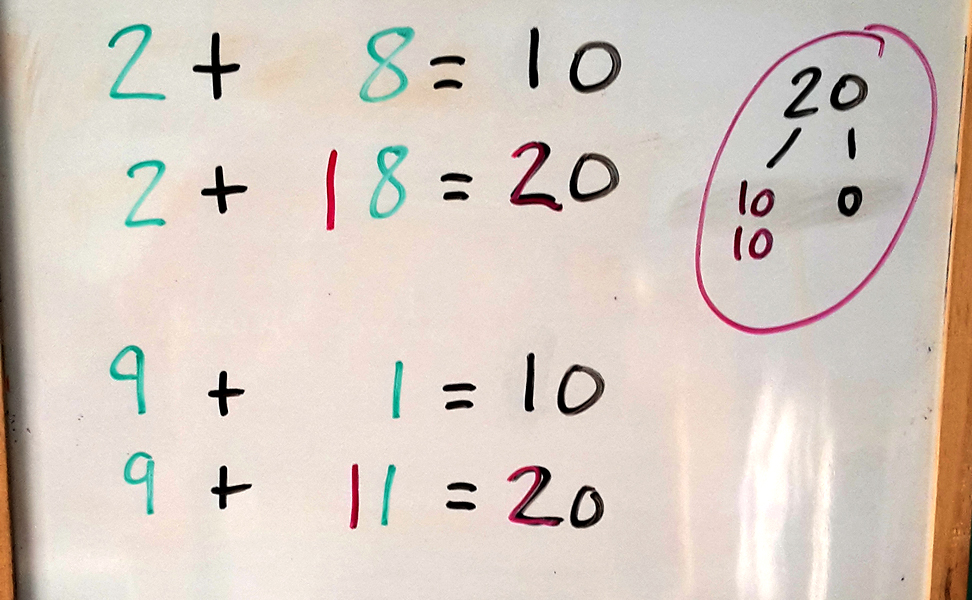
Building upon our work on learning the number bonds to 10 (posted about here and here) and their understanding of partitioning, we then expanded this knowledge to calculate and so memorise the number bonds to 20 - with the overall aim of improving their mental maths skills.
I began by giving them a quick oral quiz on which numbers "matched" with each other to give a total of 10, i.e. "What do you add to 2 to make 10?" We then revised what they knew about partitioning numbers into tens and units by going through a couple of examples together on the whiteboard - stopping on the number 20.
I then explained to them how they could use the number bonds to 10 to calculate what number they needed to make a total of 20, because 20 is simply 10 more than 10! I gave them a couple of examples on the whiteboard (e.g. see picture above) then quizzed them to check their understanding.

Finally, I gave them some pages photocopied from Letts Make It Easy... Maths & English (Age 5-6) and Letts Monster Maths - Maths (Age 5-6) to recap and reinforce.
The bottom of the first page (left) was a good opportunity to teach them the importance of showing their working out, in terms of keeping track of what they're doing and working things out step by step, in order to pick up on where they might have made a mistake.
Wednesday, 3 January 2018
Number Bonds to 10 (Part 2)
Following on from their mini maths investigation into which two numbers can add together to make 10, I made up a few simple games to further practise these bonds using a pack of standard playing cards.

For all of these, the first step is to take out the 10s, Jacks, Queens, Kings and Jokers. Ace always represents 1. When I say "the matching card", what I mean is the one with the number which added together would make 10, e.g. A matches with 9, 2 with 8, 3 with 7, etc. etc.
1) A variation of "Snap!" [2 players (& dealer)]
I was the dealer and had all the clubs, A - 9. The girls had one red suit each, i.e. diamonds A - 9 and hearts A - 9. They had their cards face up in front of them on the table, put in numerical order to make it simpler (they could have held them in their hands, but as we were using a standard pack of full sized cards they were a little tricky for them to manipulate so I decided this way would be easier). I had my cards shuffled into a random order. The choice in suits was to differentiate between the dealer's cards and the players' cards.
The game was simple: I would place a card down in the middle; the first person to put the matching card on top and shout "Snap!" would win the card. Whoever had the most black cards at the end was the winner.
If you're only playing with one child this is easily adapted into a game the parent can play in as the second player by having the black cards shuffled and face down in the centre. Each player can then take turns to flip one card over into the middle.
2) Beat the Clock [1 player]
You only need two suits for this, one black and one red. I chose clubs and hearts. 😊 You also need a stopwatch.
Place the black cards face up on the table. We started with them in numerical order to make it easier.
Shuffle the red cards and hold them face down in one hand.
Start the clock! Flip one card in your hand over at a time and place it on top of the matching card on the table. The aim is to do this as fast as possible, then make a record of your time at the end.
The first time we did this, the girls both averaged 2 and a half minutes! They took their time flipping the card over and thinking about how many more were needed to make 10, sometimes checking on their fingers before placing it down... They didn't really have a concept of time, but I let them be slow as I wanted them to see themselves improve the next time. 😜 After they each had a go I modelled how to do it as fast as possible, whilst still pausing to say out loud what I was doing: "First card, 4; 4 plus 6 is 10; 4 goes on top of the 6. 2; 2 plus 8 is 10; 2 goes here," etc.) I wrote all our times on our whiteboard and said we'd try this again tomorrow to see if we could improve. And they did! We've been playing this game daily for a few days now and they're now averaging 40 seconds to complete it (my best so far is 10 seconds, so you have some idea of expectations!).
We play by having the twin who isn't using the cards to be in charge of the stopwatch. This has also definitely helped their understanding of time and how long 1 second actually is!
You can make the game a little more challenging by having the cards on the table in a random order, or in a square kind of shape rather than a line, so the kids can practise their skim reading skills at the same time. Depending on your child, they might notice that when the cards on the table are in numerical order then the cards they place on top are simply in backwards numerical order - so this helps stop them "cheating" by using this fact (although if they notice this fact themselves, well done to them as this can be a teaching point in itself!).
3) Flashcards [1+ players & dealer]
This is similar to the first game, but removes a little of the competitive element if you want to. 😛
Each player has one suit each. The players have their cards face up in front of them (in their hands or on the table) and in numerical order to make them easier to find (they don't need to be in order, of course, but this could be a good discussion point as to why they might want them that way and an introduction to strategic thinking!). The dealer has their cards shuffled into a random order.
The dealer holds up a card, one at a time, and the players need to find the matching card and hold it up. They can shout out the answer once they have the card, or they can stay quiet so it's not as clear who was faster! You can also choose to have the faster one take the dealer's card and compare who has the most at the end, or just congratulate them for getting the right answer and continue playing. It's up to you and what mood your kids are in at the time!
You could even play this with the dealer just holding up random cards and the kids shouting out the matching number as fast as they can, but I like the fine motor skills practise and skim reading practise the kids get from having their own suit of cards to physically find the answer with. Similarly, you could get the same effect from the dealer using something physical, e.g. 10 cubes in an opaque bag, instead of cards. The dealer takes out a random number of cubes and shows them to the children (dealer can count them out or leave the children to count them together/quietly to themselves for practise); the children have to work out how many cubes are left in the bag and hold up the card with the right number.
4) A variation of "Old Maid" [3 players+]
Put a card of your choice back into the pack to represent the Old Maid, e.g. one of the Queens or a Joker. Shuffle the cards and deal them equally to each player (I joined in with this game so we had three people playing - wouldn't really have been fun otherwise!).
First, each player looks at their cards privately and discards any pairs of matching cards. The goal is to get rid of all your cards and not be left with the Old Maid at the end. Alternatively, you could play this without the Old Maid (i.e. Queen/Joker) and just see which player is the first to get rid of all their cards, as this makes the game shorter (the winner doesn't feel left out!) and you don't really have a loser (which avoids temper tantrums amongst some kids!).
Once the matching pairs have been discarded, each player holds their remaining cards in their hands facing them so the other players can't see what they have (ideally you would fan them out in one hand, but this was a little tricky for my 4 year olds so I just let them hold them however).
You then take it in turns to go round the circle and take one card from the person next to you. If you get a matching pair, you discard it. Keep going until a) someone discards all their cards and is the winner or b) someone is left with the Old Maid at the end and is the loser. We play the 2nd version using the Joker - whoever is left with the Joker at the end needs to tell a joke/do something funny to try and make the others laugh. 😂
----------
That's all for now! If I think of or find any more games, I'll update this post with the summary. 😊
Subscribe to:
Posts (Atom)