Showing posts with label animals. Show all posts

Saturday, 2 November 2019

Summer of Year 1 - Autumn of Year 2

A list of some of the things we've done over the last few months... No time for proper updates! SubhanAllah, my youngest brother was diagnosed with stage 4b lymphoma and things were a bit busy and a lot of going back and forth between Bristol, Birmingham and Ipswich. Alhamdulillah, he's finished his chemo course and seems to be doing well (and MashaAllah, the work we've done in Science recently on infection and the human body was really useful in the girls being able to understand pretty quickly why I was upset to hear the news and why we need to make lots of dua that Mamu gets better soon). Next time we visit will be next month, inshaAllah. 😄

So aside from the usual Literacy and Numeracy, guided by the Year 2 NC (going through the list and filling in all the gaps), we did the following:

1) Definition of habitats: research in non-fiction books, identify from fiction books, create a poster of a habitat of choice (including marking locations on a world map) which contained examples of plants and animals found in that habitat. Rehearse and give a presentation of their poster to each other, giving feedback on how to improve, then give an improved presentation to Papa. Convert their posters to PowerPoints (skills: typing, text boxes, inserting images, animations) and show this as a presentation to Papa.


2) Art trail around Ipswich, looking for Elmer statues. Map reading, walking, exploring, checking off a list, art appreciation & discussion... The girls then designed and named their own Elmers on pieces of scrap paper and compiled these into a booklet each. They tried to copy the art trail Elmers and came up with puns where they could!

3) Visit to a working water mill, where they grind their own flour and make their own bread - Tide Mill in Woodbridge. We took the train there with Nani, which was an experience in itself! The mill itself was really educational and child friendly. Definitely worth a visit if you're in the area! The girls got to help start the water wheel by turning a handle and follow all the ropes and pulleys to the top of the mill. They were able to identify where the old pulleys should have been connected in the roof for the bags of flour to be lifted through the hatch, and also understood the mechanism behind the cogs turning and affecting each other. While there we also did some bird spotting from the lookout area and talked about how the mill was connected to the river. This led onto discussions to do with water sources and the sea, which inspired some more visits whilst in Ipswich...


4) We went to Felixstowe beach twice - once on the train with Nani during the daytime and another at sunset by car with Papa. Both experiences felt completely different despite being to the same place, which led to some good discussions. On our first trip they had fish & chips and ice-cream on the pier, played in the sand and F was brave enough to paddle in the sea. On the second trip we went for a short stroll on the beach and they played in the sand by the light of some coloured string lanterns hung across the promenade. It was interesting to watch the sunset on the horizon and see how the sky changed colour and then how the sea faded to black so it was impossible to tell where the sea ended and the sky began - the only clues the sea was there at all were a few lights from ships far in the distance. This led to talks about lighthouses and on how vast the sea is.

5) We walked down to Ipswich docks (only 5-10min from my parents' house!) and compared how the water was flowing to the river we saw at Woodbridge. Why? M had the idea that maybe both the water in the docks and the water from Tide Mill would end up in Felixstowe to meet the sea, so we checked on Google maps by zooming out and saw she was right! We didn't have time this visit to see, but I'd like to take them to Orwell Bridge so they can compare how the river looks there to how it was after the docks (and also to the little streams we saw in Holywells Park).


6) Which is the most popular car colour in Ipswich? The twins came up with a method of answering this question (watch the cars on the main road outside Nani's house) and keep a tally chart. We repeated this on two different days and compared the results (the same top three colours but not the same most popular colour on each day!) then turned these results into a bar chart (column addition practise to collate their results from both days). I helped them with this through prompts and questions and then wrote some simple questions about their data for them to answer.


7) We went to a free pizza making workshop at Pizza Express, organised by another home ed mum. The 3 eldest girls learnt a little about Italy and why a margarita has that name (the colours of the Italian flag represented by the toppings), tasted some pizza toppings then made their own margaritas on a pre-made base. The next week they wanted to make pizza at home from scratch, so I found a simple dough using Greek yoghurt and flour they could do independently. They made the dough themselves while I helped with the oven parts and making the sauce (tomato puree, oil & herbs). They put all the toppings on themselves and decided to make tuna, sweetcorn, mozzarella and cheddar.


8) Bake Off inspired baking: taking it in turns to bake cupcakes with me, one person each week. They designed their cupcake on paper first (sponge flavour & decorations) then baked with my guidance (they did measuring themselves for once!). After we all had a turn, we discussed which bake was our favourite and why. Mine was mint chocolate and my favourite lol - will need to post recipe soon inshaAllah!

9) First piece of extended writing in a while... We're currently reading the Famous Five series together and they're really enjoying them, so I used this as a basis for their writing. After a particularly eventful chapter, we did some hotseating on the characters' thoughts/feelings then I modelled writing a simple diary entry on A3 paper. Together, we discussed what the features of a diary entry might be and annotated them on the paper. Then the twins wrote their own diary entries as different characters from the book. When they thought they were finished, they referred to the poster and added to their work.


10) Bouncing ball investigation (as M asked why did the ball bounce higher in the kitchen compared to the sitting room?). Discussed in terms of energy (potential, kinetic) and energy being absorbed. Twins came up with ideas on how to test these factors (i.e. strength of throw, height dropped, floor surface) and how to measure - describe in words or use tape measure? Both ways difficult but tape measure was preferred option! One of the results didn't match our predictions, so we did some further investigations explore why. M came up with hypothesis 1 and F with hypothesis 2, with them both working together to think of how we could test each one. We put both ideas together to come up with a reason to explain why that one result didn't match.


Sunday, 10 March 2019

Lapworth Museum

We visited Lapworth Museum to learn about skeletons and fossils in a little more detail - mainly to see the allosaurus on display!

The museum doesn't open until 12pm on a weekend (I thought it opened at 10am ) so we arrived on campus half an hour before opening time... But alhamdulillah the weather was fine so we used the time for a quick trip down memory lane - we walked through the university centre (where everything was closed lol) and up the stairs to one of the lecture theatres, but it was locked! And past the Old Gym (which isn't so old anymore!) where my husband and I met. 💕😂 The campus was pretty much dead when we arrived but by midday lots of people started arriving - so we used all this for a short discussion about uni life and student habits. 😀


Inside Lapworth, we looked at all the skeletons on display - revising our work on herbivores/carnivores and using fossils for clues. F had recently asked if there were any flying dinosaurs to which I'd answered pterodactyl, and fortunately there was one on display hanging from the ceiling.

allosaurus cast

pterodactyl cast

allosaurus skull - feel its teeth!

another carniverous dinosaur...

hippopotamus skull

Most of the exhibits just showed parts of the skeleton as opposed to the whole thing, eg the femur of a stegosaurus, so there were some good opportunities to revise bone names and find the equivalent on their own bodies.

Surprisingly for me though, the part of the museum they enjoyed the most was looking at all the different rocks and gemstones upstairs!

rock wall - feel and describe their textures!

my favourite stone because it's my favourite colour~
their feedback in the bottom right!

We managed to look around the whole museum comfortably in just over an hour. Definitely somewhere worth visiting again next time we're on campus or when it ties in with another topic inshaAllah!

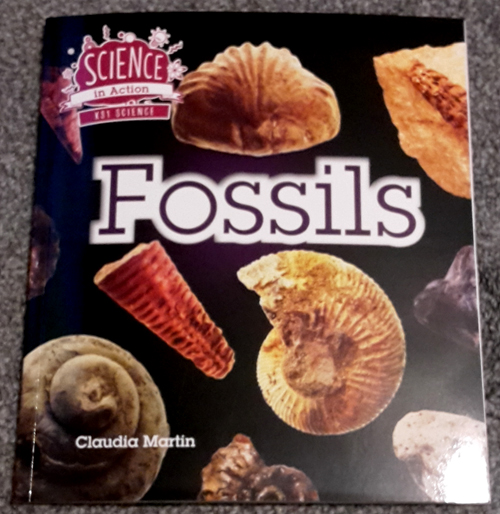
When we got home, I put out the Fossils book we have:


I really like this book series, but this served as a reminder how careful we need to be with the educational material we give to our children - especially when it looks like a trusted source - since the last few pages of the book are dedicated to the theory of humans evolving from apes and present it as non-disputable fact:


I don't wish for the girls to grow up sheltered, so I thought since it came up we may as well discuss it. Rather than censor the page completely, I decided to stick some flaps over the top instead with the following:


So the girls can still see the information underneath, but they can treat it in the same way as they treat beliefs from other religions.

We also spoke a little about scientific theory and how the principle is correct, to have a prediction and look for evidence (just like we do for our experiments!), but how important it is not to have preconceived biases or we end up with the wrong conclusions.

Tuesday, 5 March 2019

Skeletons (& Fossils)

Following on from our work on teeth, I thought it made sense to look at the skeleton next!

We read through some books on the subject and talked about what they already knew.

Then, we worked through the following worksheets together:


Some notes about the pages...

1) I picked out a few bones I thought were the most prominent... I decided against naming the individual arm and leg bones at this point - it's enough for me for now they just recognise there are bones in their arms and legs! I deliberately left the lines off for them to draw themselves, so I could check their understanding more. Once they were done, I asked them how they could make their diagram clearer? M said straightaway to colour it in and F immediately chimed in with, "Like the teeth diagram last time!" 👍

2) The pictures at the bottom of this sheet are meant to be clues. So a blob, i.e. no structure (skeleton provides a frame and support), a shield, i.e. protection (it protects our soft internal organs), and a statue, i.e. no movement (skeleton has joints for movement).

3) MashaAllah, they guessed straightaway the bottom skeleton was a horse! There was some debate over which was the cat and which was the dog, but then they looked at the tails and both agreed the top one was the cat. 😁

4) I wanted to use this opportunity to practise their scientific thinking. We talked about dinosaurs being extinct so there are no real life examples around nowadays for us to look at, so how do we know what they were like? By using knowledge we have from other things as ideas (look at the animals alive today which are carnivores!) and looking carefully at e.g. the dinosaurs' skeletons for clues. For the question about the stegosaurus' tail, F said, "Maybe it used it for killing other animals..." to which I was impressed but thought I'd ask to check what she meant... Why would a herbivore want to kill other animals? "Because it wanted to give them to the tyrannosaurus to eat!" Lol. A bit more discussion about what the T Rex might have eaten and she came to a different conclusion herself. 😂

You can download our worksheets here.


While they were working through, I had the sudden inspiration to make gingerbread men but to decorate them by drawing skeletons with white icing. I explained my idea to them to see what they thought... What could we use to draw the skeleton with? Icing or white chocolate? They decided chocolate... But instead of gingerbread, what kind of biscuit should we make to make the white chocolate stand out? M said a black one. 😂 So I suggested chocolate... They agreed. 😋 I've not tried making chocolate shortbread before, but these turned out ok! Will make a separate post soon for the recipe, inshaAllah.

Finally, we made model skeletons using the template in the link above.


We did this activity on a different day as a kind of revision.

First, I asked the girls to colour their skeletons in but using a different colour for each different bone (and the same colour for bones which were the same!). As they coloured, we talked about which bone they were colouring to reinforce the new vocabulary, as well as casually introduce a few more (e.g. breastbone, shoulder plates, kneecaps, etc.). Even though teeth are part of the skeleton, they're not bones so not coloured in. 😁

Before they cut the pieces out, I explained what the end product was supposed to be and held the paper up to ask if they thought the material was strong enough... F said no, it was too flexible! 👍 So how could we make the paper stronger? F said to stick it onto card - so we did. After gluing the whole sheet onto a piece of A4 card, the girls cut the bones out.

I helped Z with her cutting, but she did all the colouring herself!

Once they were done, I asked the girls to lay their skeletons out flat, putting the bones together like a jigsaw.

Finally, I took out the split pins and demonstrated using one to join two of Z's pieces together. I used a sewing pin to make a small hole to make it easier to push the split pins through, then let the twins get on with putting their skeletons together by themselves. Z handed me pins and I asked for her approval before joining each piece. 😂

Sunday, 3 March 2019

Teeth, teeth, teeth

Time to start a new Science topic! This half term, I wanted to do more about the human body - because the girls have started asking questions (How do we breathe? Why does exercise make me tired? What are our hearts for?) and it'll tick off a few of the NC targets for Year 2 to do with health, hygiene and living things.

To begin with, I thought we'd look at teeth because within the past couple of weeks F has got her first wobbly tooth (went to the dentist to make sure because I wasn't expecting it to happen for at least another year!) and M has got an adult tooth growing in behind her bottom incisors despite not having any teeth wobbly yet (yep, got the dentist to check this too and apparently very common! The adult tooth should force the milk teeth out, only rarely when it doesn't would they need to extract the baby teeth, so inshaAllah M won't need that to happen!) - lots of questions about what's going on in their mouths from them! So I thought it simplest just to do a couple of lessons on the subject instead of simply answering them. 😀

We began by looking through our science collection then working through the following sheets together:


You can download our worksheets here.

For the first sheet, the diagram of the teeth, I asked them how they could make it easier to understand (referring back to how we made a diagram of asteroids, comets and meteors), because it was already a drawing and it had labels... The answer was to colour it so all the same kinds of teeth were the same colour. When they were done they commented that it was really quick to see which kinds of teeth were where now. 👍

Wednesday, 28 March 2018

Sorting Animals via a Two-Way Table


As mentioned in this post, we repeated the sorting activity using a different location: this time the Birmingham Wildlife Conservation Park. Our trip to the zoo is still being postponed for better weather (assuming we go in a couple of months it'll serve as good revision insha'Allah 😂) so this was a nice small-scale version of that! You'll notice the rows only have 3 of the 5 classifications as they were the only ones on display. We spent around half a day there, with a picnic and play in the playground, and that was more than enough time to see all the animals at a leisurely pace.

I picked up some of the free leaflets in the foyer and along with some others I had been keeping from the local library, the girls had a large selection of cut-out pictures to choose from. They had to think whether the animal was one they had seen on the day (i.e. they couldn't use the picture of the rhino!) - which was good for memory as we did this activity about a week after we visited - and then sort them into the correct box depending on their classification and diet. This activity was noticeably quicker than the last time we did it, showing their understanding in all areas had had time to solidify... Especially in terms of reading the table and knowing what each box meant!

Meanwhile, our two-year-old chose whichever picture she liked from the pile and made a collage of animals on coloured card - practising her gluing skills, spatial awareness (she didn't want to have them overlapping!) and naming each animal she chose. 👌

Tuesday, 13 March 2018

Pine Cone Bird Feeders


We made these as part of our (free!) weekly allotments session, organised by a local children's centre. 🌱

You will need:
Pine cones
Peanut butter + spoon
Mixed seeds + shallow container (e.g. tupperware)
Wool + scissors

1) Spread peanut butter generously over the pine cone.
2) Pour some seeds into a shallow container and roll the pine cone around inside until all the peanut butter is covered.
3) Cut and tie a piece of wool to the top of the cone.
4) Hang the bird feeder in the garden. 🐦🐦🐦


This was simple enough for the twins to do independently (I just helped with tieing the knot in the wool) and my 2 year old enjoyed making one as well!

The peanut butter serves as a nutritious "glue" to stick the seeds on, but you can use alternative bird-friendly fats instead if you/your child has a peanut allergy, e.g. vegetable shortening as a vegetarian option, or something like suet.

Monday, 5 February 2018

Different Kinds of Pets


I wanted to introduce the girls into sorting things out using a two-way table, as they were already pretty good at sorting things into groups. The NC also mentions being familiar with a variety of common pets, so I decided to combine the two things together.

We visited our local Pets At Home store, walked around looking at the shelves and display animals, taking photos and discussing what we saw. A free mini day out before popping next door to Asda lol.

When we got home, we looked through the photos one by one and together we sorted the animals into the correct boxes. The pet store was good in that the display animals all had little information plaques to say what the animals needed to be fed (this was especially useful when it came to the different kinds of fish!), or the pet food in the aisles had a picture of the animal it was for and a description of what was inside.

I quite liked this activity as a recap of the work done so far. The weather is brightening up too so I'd like to repeat it after a trip to the local zoo, insha'Allah. Hopefully there they can find some amphibians this time too!

You can download the worksheet here.

If you just wanted to focus on the 2-way sorting and recapping the key vocabulary, you could also do this with pictures of familiar animals instead. You could print some out or cut up a free leaflet for a zoo/sealife centre etc. which you often find in the library.

Monday, 29 January 2018

Carnivores, Omnivores & Herbivores

I introduced the terms "carnivore", "herbivore" and "omnivore" to the girls just through casual discussion over a few days. For example, when we we came across a rabbit in a book we talked about how it only ate things like grass, hay and carrots - it didn't eat meat so it was a herbivore. When we read a book about sharks, it explained how great white sharks have sharp teeth to help them catch their prey - they only eat meat so they were carnivores. One of the girls asked what we were, since we eat both meat and fruit/vegetables... So I told them we were omnivores.

Silly ways to help them remember:

Carnivores: only eat meat/animals. When you say "carrrrrnivore" you need to growl like a tiger, showing your sharp teeth!

Herbivores: only eat plants. We grow herbs at the allotments and put them in our cooking; herbs are plants!

Omnivores: eat both meat and plants. They OM NOM NOM everything!


Before we could work on sorting animals by what they eat, first I wanted to clarify for them what exactly constituted as meat or plants, so I made the above worksheet.

The first side is a sorting activity thinking about whether the pictures shown are meat or plants. The girls cut the pictures out themselves and then arranged them where they thought they should go. I checked them before they glued them down.

Meat: chicken, mouse, fly, cow, worm, fish

Plants: grass, nuts, vegetables, fruit, trees/leaves, flowers

I thought it was important to include insects in the meat section and things like nuts in the plants section - things the girls wouldn't automatically associate with being either meat or plants! As they stuck the pictures down we talked about the kinds of animals who might eat those things.

At the bottom of the page are the three keywords, arranged in a way that shows the carnivores eat only from the meat section, the herbivores only from the plants section and the omnivores in the middle overlapping both sections. We talked about this before moving on to the second worksheet. (My husband thought the layout was a little confusing: I think when I repeat this for my youngest I might edit it so the titles "Meat" and "Plants" are bigger and in the centre of the box, with the pictures stuck around the outside like a spider diagram?)

The second worksheet is a simple complete-the-sentence activity, using the phrases at the bottom of the page to reinforce what we discussed.

You can download the worksheets here.

Wednesday, 24 January 2018

Which Animal is the Odd One Out?


To get the girls thinking more about the features of different animals, I created a spot-the-difference worksheet for them to work through. The first row of 3 features all mammals, the second birds, then fish, reptiles, amphibians and lastly a mixture of classifications.

They needed a little prompting at first to look carefully at things such as colour, shape, if they had fur or feathers, how many legs, where they lived, etc. - what do two have the same while the other one is different? But they soon got the hang of it.

I liked how they both came up with different animals or different reasons if they chose the same animal. My first choices were different from theirs too! So there's a lot of flexibility in this activity. 😊

You can download the worksheet here.