I looked on Google for examples of shape poems for KS1 aged children and put together a sheet of examples (download here).
We read through the sheet together and talked about what they liked/disliked, which was their favourite and why, what kinds of layouts did they have and what they thought made something a shape poem. Did it have to rhyme? Did it have to fill the picture or make a picture? Did it have to be full sentences or just words? Did all the writing have to be the same size? etc. etc.! Then I stuck it to the wall as a reminder.
Continuing with our plants theme, I decided we'd do a shape poem about flowers.
On the whiteboard, we discussed the kinds of things we might talk about in our poems. Then we talked about how we might write those ideas into the shape of a flower.
I gave them a faded template of a flower for them to use (in the above download file). Z really wanted to join in so I sat with her as she wanted to know how to spell words, so the twins ended up working independently. I originally planned to sit with them and do more thesaurus work, but it didn't work out that way! And they weren't inclined to plan first, they just wanted to write straight onto the flower. 😏
When they were done, we mounted these onto coloured paper and put them on display next to their acrostics. 😄😄
Blue: F, Green: M, Orange: Z
The twins enjoyed turning the paper to write their words in a way which fit in the petals and in the centre!
Z's poem says: "orange, red, pink" "poppy" "beautiful" "smell fresh and nice" "flower" "roses" "make me happy when they grow"
I asked them if they wanted to do their own shape poem about anything, drawing the picture themselves, but they said no. 😆 They'd had enough of them. 😂😂
Blog of a Mama Bear to 4 cubs under the age of 8. A place to share ideas, free resources and adventures we get up to on our homeschooling journey... Loosely following the National Curriculum for the core subjects, as well as Arabic language, Quran/Hifz and Islamic Studies.
Showing posts with label literacy. Show all posts
Thursday, 5 March 2020
Saturday, 29 February 2020
Acrostic Poetry
We haven't done any poetry for a while! So I checked online for a list of suggested genres and picked a few for us to look at over the next few weeks inshaAllah: acrostics, shape poems and couplets.
We started by visiting the library and looking for poetry books - not in any particular genre - just for general inspiration.
Fortunately, there were some examples of acrostics in one of the books we took out!
We read the examples together and I asked the girls what they thought an acrostic poem was... They said it has a word going vertically which is what the poem is about. 👍 Then I quickly made this up on the whiteboard to demonstrate!
As our current science topic is to do with plants, I thought it'd be nice to link our poetry to this. We talked together and wrote the following two examples:
Then I challenged the girls to write their own using a plant-related word as their theme. We talked about how poetry doesn't have to rhyme! And the meaning of what they want to say is more important. 😁 When they were finished, we used thesauruses to make their writing more interesting. Finally, they wrote their poems out in their best handwriting, illustrated them, then trimmed and mounted them onto coloured paper.
Papa was late coming home that evening, so we left this final acrostic on the whiteboard for him... The girls eagerly asked him if he saw it the next morning, but unfortunately he was too tired to notice. 😂
We started by visiting the library and looking for poetry books - not in any particular genre - just for general inspiration.
Fortunately, there were some examples of acrostics in one of the books we took out!
We read the examples together and I asked the girls what they thought an acrostic poem was... They said it has a word going vertically which is what the poem is about. 👍 Then I quickly made this up on the whiteboard to demonstrate!
As our current science topic is to do with plants, I thought it'd be nice to link our poetry to this. We talked together and wrote the following two examples:
Then I challenged the girls to write their own using a plant-related word as their theme. We talked about how poetry doesn't have to rhyme! And the meaning of what they want to say is more important. 😁 When they were finished, we used thesauruses to make their writing more interesting. Finally, they wrote their poems out in their best handwriting, illustrated them, then trimmed and mounted them onto coloured paper.
Papa was late coming home that evening, so we left this final acrostic on the whiteboard for him... The girls eagerly asked him if he saw it the next morning, but unfortunately he was too tired to notice. 😂
Friday, 14 February 2020
Writing Informal Emails
Part two of learning about letters was to compare to writing and sending emails!
First, the twins did a comprehension exercise based on an email text (from this book) and we talked briefly about the conventions in layout: the email subject, email addresses, the similar layout in terms of paragraphs and a "Dear...", "From..." beginning and end.
Then, I set up email accounts for the girls - including Z, as she had written a letter and posted it too - using Gmail. In hindsight, I wish I had adjusted their birth years so I could automatically forward their emails to mine (Google doesn't allow automatic forwarding for child accounts! And neither can I add their accounts to my phone as I set my email as the parent account which is already signed in on my phone... Settings might get confused, apparently, so it's not possible 😖) as now I need to manually log in to their accounts to check for replies... But this is a lesson in itself for them re: the conveniences of snail mail vs electronic! It may arrive there straightaway but that isn't much use if you forget to sign in and check. 😂
They watched me set up their accounts (the username F wanted was already taken so we added a number to the end; we talked about how usernames/email addresses are unique for everyone in the whole world!) and came up with a password (their first one lol... I set all 3 as the same for ease 😝).
When they composed their emails, in turn, we looked at the layout of the inbox, how to write an email by clicking "compose", what the subject line is for and where to put the recipient's address. They wrote a simple email to the same aunts they had sent letters to, explaining they were comparing the two forms of communication, and added emojis to their emails (which they enjoyed the most lol).
We talked about how email is free to do, how long it takes to arrive, the convenience of not needing to physically buy stamps or walk to a postbox and how mistakes in an email can be easily corrected, compared to rubbing out or crossing out written mistakes in a letter. We also didn't need to write the date or our own address because it was put there automatically for us.
So what could be the benefits of sending letters by post? Because you don't have to remember to check for a reply, it just comes! And if you want to send something (like Nani sent a present in the post to us) then you can't email it, you have to post it... And it's fun getting post. 😂
Tuesday, 11 February 2020
Writing Informal Letters
I bought the books The Jolly Postman and Dragon Post from Amazon as an introduction to the topic. We also watched the relevant episode of Let's Play on Amazon Prime (the twins are getting a bit old for this but still enjoyable for Z!).
We looked at the layouts of the different letters in the books to see if there was anything they all had in common - what were the features of a letter? Was there a difference between letters from friends (informal) and letters from businesses (formal)?
On a piece of coloured A4 paper, we wrote our own example letter (to Julian from Aunt Fanny - Famous Five themed again, their choice!) then glued in the centre of A3 paper and annotated it with the features we came up with.
Why is it useful to write your own address in the corner? So the recipient has it if they want to send a reply! Why is it useful to have the date? Because the letter won't arrive straightaway so it's good to know when it was sent!
We talked about how letters get to where we want them to go to and watched a couple of YouTube videos about Royal Mail - one posted only a few years ago and the other 10 years ago. We talked about how clever the machines were and how they hadn't really changed in 10 years... But before the machines were invented it must have taken a lot longer and been a lot more difficult!
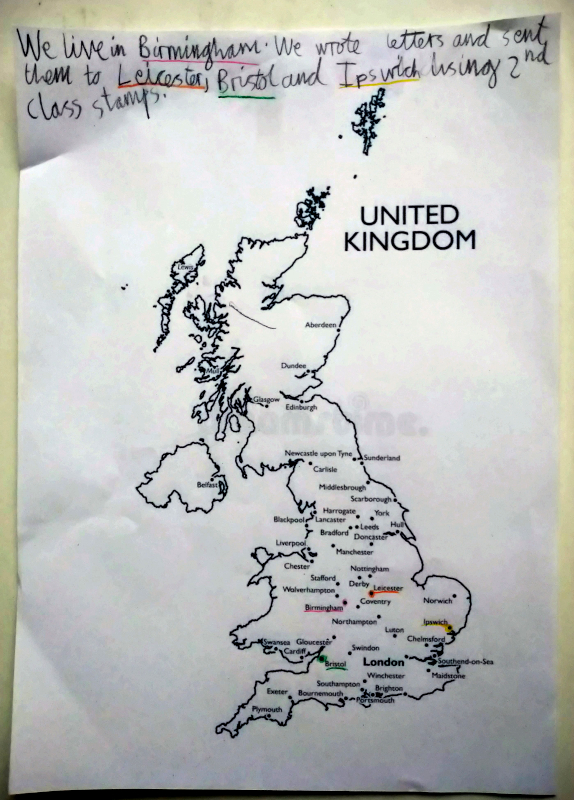
We thought about who they could write letters to - who lived in the UK but not in Birmingham? Z cleverly commented there was no point wasting money posting letters to people in Birmingham because we could just give it to them instead! After going through all the possibilities they decided to write a letter each to some of my sisters living in different places (at school in Ipswich, university in Bristol and work in Leicester!). We thought it would be interesting to see if they would all receive their letters at the same time if we posted them all into the same postbox at the same time...
We looked into the difference between 1st class and 2nd class post. 1st class is meant to arrive the next working day ("What's a working day?!") including Saturday; 2nd class can take 2-3 working days to arrive. So we decided to use 2nd class for our experiment. We also talked about which kind of stamp cost more and why.
They wrote their letters, using the annotated poster from before as a guide, and we talked about the conventions of an envelope: stamp in the top right corner, address in the centre with the recipient's name at the top & postcode at the bottom, return address on the back.
We walked down the road to the nearest postbox for them to post their letters. While there, we read the information about last collection times and looked for the keyhole and handle to open the postbox. M was pleased she could explain what the "line" was down the side of the postbox - it's the door! It was a bit of a cold, windy day (remnants of Storm Ciara from the weekend!) so we talked about the inconvenience of needing to go out to send a message to someone faraway, as opposed to the technology nowadays of phones, emails and WhatsApp, etc. - all of which are sent straightaway and don't take days to arrive!
I found a simple map of the UK on Google Images which had Birmingham, Leicester, Bristol and Ipswich marked and printed it out for the girls. They needed to find the four cities and colour them different colours, then write a couple of sentences to explain what we had done.
When the letters arrive InshaAllah they can add at the bottom how long it took for their aunts to receive them! They're expecting Ipswich to maybe take longer because it's the furthest away, and Leicester to be delivered the quickest, but we'll see. 😁
We looked at the layouts of the different letters in the books to see if there was anything they all had in common - what were the features of a letter? Was there a difference between letters from friends (informal) and letters from businesses (formal)?
On a piece of coloured A4 paper, we wrote our own example letter (to Julian from Aunt Fanny - Famous Five themed again, their choice!) then glued in the centre of A3 paper and annotated it with the features we came up with.
Why is it useful to write your own address in the corner? So the recipient has it if they want to send a reply! Why is it useful to have the date? Because the letter won't arrive straightaway so it's good to know when it was sent!
We talked about how letters get to where we want them to go to and watched a couple of YouTube videos about Royal Mail - one posted only a few years ago and the other 10 years ago. We talked about how clever the machines were and how they hadn't really changed in 10 years... But before the machines were invented it must have taken a lot longer and been a lot more difficult!
We thought about who they could write letters to - who lived in the UK but not in Birmingham? Z cleverly commented there was no point wasting money posting letters to people in Birmingham because we could just give it to them instead! After going through all the possibilities they decided to write a letter each to some of my sisters living in different places (at school in Ipswich, university in Bristol and work in Leicester!). We thought it would be interesting to see if they would all receive their letters at the same time if we posted them all into the same postbox at the same time...
We looked into the difference between 1st class and 2nd class post. 1st class is meant to arrive the next working day ("What's a working day?!") including Saturday; 2nd class can take 2-3 working days to arrive. So we decided to use 2nd class for our experiment. We also talked about which kind of stamp cost more and why.
They wrote their letters, using the annotated poster from before as a guide, and we talked about the conventions of an envelope: stamp in the top right corner, address in the centre with the recipient's name at the top & postcode at the bottom, return address on the back.
We walked down the road to the nearest postbox for them to post their letters. While there, we read the information about last collection times and looked for the keyhole and handle to open the postbox. M was pleased she could explain what the "line" was down the side of the postbox - it's the door! It was a bit of a cold, windy day (remnants of Storm Ciara from the weekend!) so we talked about the inconvenience of needing to go out to send a message to someone faraway, as opposed to the technology nowadays of phones, emails and WhatsApp, etc. - all of which are sent straightaway and don't take days to arrive!
I found a simple map of the UK on Google Images which had Birmingham, Leicester, Bristol and Ipswich marked and printed it out for the girls. They needed to find the four cities and colour them different colours, then write a couple of sentences to explain what we had done.
When the letters arrive InshaAllah they can add at the bottom how long it took for their aunts to receive them! They're expecting Ipswich to maybe take longer because it's the furthest away, and Leicester to be delivered the quickest, but we'll see. 😁
Wednesday, 5 February 2020
Greek Mythology (2)
I spent some time debating how much detail we wanted to go into Greek mythology at this point in time... I didn't feel the girls would enjoy the violence aspect of the adventures at their current age... And Ancient Greek culture is a good topic base for Art, Geography and History lessons, so I'd rather have the time to plan a unit in enough detail to do it justice rather than do a rushed job now. 😶
With that in mind, I decided to use this week just to focus on the myths we've already covered in the form of another shadow puppet theatre (subtly revising work on light and shadows at the same time!).
The girls chose to do the story of King Midas and the Golden Touch.
Before they could do their play, first I had them rewrite the story in their own words in script format. This sounds a bit daunting for a 6 year old but MashaAllah they managed with some structured help!
After rereading the version in the book and comparing it with a version online (ideally we would go to the library but unfortunately we're without a car atm!), I had the girls tell me what they thought were the main parts to the story. We wrote these on scrap paper so we could then rearrange them into chronological order when they were done (this also helped them see if they had missed any key events out when summarising the story).
I gave the girls a storyboard template so they could translate the bullet point version into a storyboard. This was also useful in getting them to think about what might be on stage at that point during their shadow play.
Next, I had them write out the text in their storyboards on a new piece of paper but adding more detail, paragraphs and direct speech so it flowed like a story - and made them think about what their narrator and characters might say during the play. I had them do this pretty much independently as I wanted them to come up with different versions - a good lesson in how even though we might have the same thing to start with (we all read the same stories), they wrote them again in different ways. Maybe this could be why many different versions of the same story exist? Considering how many thousands of years old the stories are and how many times they must have been retold and passed down!
When they were finished, we recapped editing skills (we had done work that week on conjunctions and fronted adverbials, so they were looking out for those in particular!) and they made changes in a different colour.
(They wrote the words "everything" and "excitedly" at the end as spelling practise since they had misspelt them in their writing. Just chose one for them to do.😗)
Finally, I challenged them to work together on the laptop to turn their stories into one playscript. They needed to think about the layout themselves and talk together to agree on which wording to use! I created them a file on Google Docs for this so I could help with editing on my new laptop (gift from my husband, MashaAllah 😁) - they were amazed how we could all edit the same file at the same time! But it was really convenient so I think from now on we'll continue using Google Docs over Microsoft Word, inshaAllah.
The above was done over three consecutive days.
For their shadow puppets, we talked about how they could show the things turning into gold - how could they make the shadows change colour? I prompted them to think about layering - as we had previously layered blue and yellow cellophane to create a green shadow for grass - which materials could they layer to turn an opaque shadow into yellow?
When they were done and had practised it a few times, we recorded the show (each scene as a separate clip) and edited it on the laptop using Shotcut into one long video.
With that in mind, I decided to use this week just to focus on the myths we've already covered in the form of another shadow puppet theatre (subtly revising work on light and shadows at the same time!).
The girls chose to do the story of King Midas and the Golden Touch.
Before they could do their play, first I had them rewrite the story in their own words in script format. This sounds a bit daunting for a 6 year old but MashaAllah they managed with some structured help!
After rereading the version in the book and comparing it with a version online (ideally we would go to the library but unfortunately we're without a car atm!), I had the girls tell me what they thought were the main parts to the story. We wrote these on scrap paper so we could then rearrange them into chronological order when they were done (this also helped them see if they had missed any key events out when summarising the story).
I gave the girls a storyboard template so they could translate the bullet point version into a storyboard. This was also useful in getting them to think about what might be on stage at that point during their shadow play.
Next, I had them write out the text in their storyboards on a new piece of paper but adding more detail, paragraphs and direct speech so it flowed like a story - and made them think about what their narrator and characters might say during the play. I had them do this pretty much independently as I wanted them to come up with different versions - a good lesson in how even though we might have the same thing to start with (we all read the same stories), they wrote them again in different ways. Maybe this could be why many different versions of the same story exist? Considering how many thousands of years old the stories are and how many times they must have been retold and passed down!
When they were finished, we recapped editing skills (we had done work that week on conjunctions and fronted adverbials, so they were looking out for those in particular!) and they made changes in a different colour.
(They wrote the words "everything" and "excitedly" at the end as spelling practise since they had misspelt them in their writing. Just chose one for them to do.😗)
Finally, I challenged them to work together on the laptop to turn their stories into one playscript. They needed to think about the layout themselves and talk together to agree on which wording to use! I created them a file on Google Docs for this so I could help with editing on my new laptop (gift from my husband, MashaAllah 😁) - they were amazed how we could all edit the same file at the same time! But it was really convenient so I think from now on we'll continue using Google Docs over Microsoft Word, inshaAllah.
The above was done over three consecutive days.
For their shadow puppets, we talked about how they could show the things turning into gold - how could they make the shadows change colour? I prompted them to think about layering - as we had previously layered blue and yellow cellophane to create a green shadow for grass - which materials could they layer to turn an opaque shadow into yellow?
When they were done and had practised it a few times, we recorded the show (each scene as a separate clip) and edited it on the laptop using Shotcut into one long video.
Tuesday, 28 January 2020
Conjunctions
Working more on sentence level skills, I made a set of conjunctions cards for the twins (print, cut, laminate, cut!). Loosely based on the old QCA framework and posters of writing levels found on Google, I've colour coded the words by level of expected use... At the moment we're just looking at the red, orange and some of the green words (i.e. Levels 1-3).
Using our 19 chosen words, we laid them out on the table and put them in a simple sentence one by one. When we were done, I asked the twins if they could group the conjunctions by words with similar meanings/purposes (e.g. cause and effect, opposition, time, etc.). With some extra questioning, they came up with the groups below.
On a piece of A3 paper I wrote the title for them to colour, then laminated it. Using blu-tack, they then helped arrange the conjunction cards onto the poster. We now have it on display next to our whiteboard. 😊
The plan is to add to the poster as they learn new conjunctions (so the freedom is there to rearrange the cards!), have the poster there as a reference point while doing extended writing, and to take cards off and have them stuck on the table in front of them when we're doing focused work on that particular conjunction/sentence structure. InshaAllah!
You can download the file here.
Using our 19 chosen words, we laid them out on the table and put them in a simple sentence one by one. When we were done, I asked the twins if they could group the conjunctions by words with similar meanings/purposes (e.g. cause and effect, opposition, time, etc.). With some extra questioning, they came up with the groups below.
On a piece of A3 paper I wrote the title for them to colour, then laminated it. Using blu-tack, they then helped arrange the conjunction cards onto the poster. We now have it on display next to our whiteboard. 😊
The plan is to add to the poster as they learn new conjunctions (so the freedom is there to rearrange the cards!), have the poster there as a reference point while doing extended writing, and to take cards off and have them stuck on the table in front of them when we're doing focused work on that particular conjunction/sentence structure. InshaAllah!
You can download the file here.
Tuesday, 21 January 2020
Greek Mythology (1)
Since the books we have which contain fables also contain Greek myths, I thought it was better to cover them in more detail now since the girls are aware of them anyway... Rather than ignore them and let any seeds of confusion grow! Plus they come up in the Year 3 NC for Literacy.
We began by reminding ourselves who wrote the fables we had been reading - Aesop - and which country he was from - Greece. We talked a little about how he lived a very long long time ago (around 600BC, i.e. 600 years before Prophet Isa (AS) was born - which is what we call year 0 - so over 2,500 years ago!) and how we call that time period "Ancient" Greece.
They found Greece in the atlas (clue: it's in Europe...) and I asked them what they thought the climate was like and why - they said hot, M because their atlas showed olives growing there and F because it was near the equator! I gave them a printed map of Europe (from Google Images) to help familiarise them with it some more. They coloured the water first, following the coastlines and using islands as a starting place to know where the seas were, then coloured the UK followed by Greece and then other countries they had heard of with a key down the side - using their picture atlas to help.
We talked about how in those days, the Ancient Greeks didn't know about Islam. Instead of believing in Allah, they believed in lots and lots of different gods - male and female - who were all in charge of different things... So one was in charge of making things grow, one was in charge of turning night into day, one was in charge of people after they died, etc. etc. And the one in charge of them all was called Zeus. The gods and goddesses all lived together on a mountain called Olympus (the tallest mountain in Greece) where some married each other and had children and some had children with humans so the children were half-gods or demigods... MashaAllah the twins had such precious looks of disbelief on their faces as I was telling them about this! I asked them what we believe and MashaAllah they confidently replied that Allah made everything and is in charge of everything and He does not have children or partners, astaghfirullah!
Then we read through a few myths together (I wrote the word mythology on the board and explained myths is the shorter way of calling them) as examples. We used the Usborne book again, looking for Greek myths in the contents.
We read the story of King Midas followed by the story of Icarus. I asked the girls what fables are for - to teach a moral - and asked them why they thought fables and myths were together in their books... F said because Aesop lived in Ancient Greece so he wanted to write those kinds of stories. M said because they both have a lesson in them. So what were the lessons in these two myths? They came up with to not be greedy for King Midas. For Icarus, they said to listen to what you're told instead of being silly and having too much fun when you're not supposed to. 😂
Then we read the story of Persephone. Towards the end, F started laughing and asked was the story supposed to be explaining why we have winter? When I said yes she laughed more and told me no, we have winter because of the Earth going round the sun. 😜
Finally, we read the story of Pandora's box. F wasn't sure what the lesson was - don't be nosy? - but M understood it as explaining the reason why there are all the bad things in the world.
To finish, I asked them what they thought the features of Greek mythology might be. They came up with teaching a lesson - I clarified this could either be as a moral or explaining something about the world - and having Greek gods/goddesses as characters. They also said Greek myths didn't have to be as short and simple as fables were.
Throughout the rest of the week we watched episodes from Super Wings which were set in Europe, since the series was streaming on Amazon Prime at the time.
We began by reminding ourselves who wrote the fables we had been reading - Aesop - and which country he was from - Greece. We talked a little about how he lived a very long long time ago (around 600BC, i.e. 600 years before Prophet Isa (AS) was born - which is what we call year 0 - so over 2,500 years ago!) and how we call that time period "Ancient" Greece.
They found Greece in the atlas (clue: it's in Europe...) and I asked them what they thought the climate was like and why - they said hot, M because their atlas showed olives growing there and F because it was near the equator! I gave them a printed map of Europe (from Google Images) to help familiarise them with it some more. They coloured the water first, following the coastlines and using islands as a starting place to know where the seas were, then coloured the UK followed by Greece and then other countries they had heard of with a key down the side - using their picture atlas to help.
We talked about how in those days, the Ancient Greeks didn't know about Islam. Instead of believing in Allah, they believed in lots and lots of different gods - male and female - who were all in charge of different things... So one was in charge of making things grow, one was in charge of turning night into day, one was in charge of people after they died, etc. etc. And the one in charge of them all was called Zeus. The gods and goddesses all lived together on a mountain called Olympus (the tallest mountain in Greece) where some married each other and had children and some had children with humans so the children were half-gods or demigods... MashaAllah the twins had such precious looks of disbelief on their faces as I was telling them about this! I asked them what we believe and MashaAllah they confidently replied that Allah made everything and is in charge of everything and He does not have children or partners, astaghfirullah!
Then we read through a few myths together (I wrote the word mythology on the board and explained myths is the shorter way of calling them) as examples. We used the Usborne book again, looking for Greek myths in the contents.
We read the story of King Midas followed by the story of Icarus. I asked the girls what fables are for - to teach a moral - and asked them why they thought fables and myths were together in their books... F said because Aesop lived in Ancient Greece so he wanted to write those kinds of stories. M said because they both have a lesson in them. So what were the lessons in these two myths? They came up with to not be greedy for King Midas. For Icarus, they said to listen to what you're told instead of being silly and having too much fun when you're not supposed to. 😂
Then we read the story of Persephone. Towards the end, F started laughing and asked was the story supposed to be explaining why we have winter? When I said yes she laughed more and told me no, we have winter because of the Earth going round the sun. 😜
Finally, we read the story of Pandora's box. F wasn't sure what the lesson was - don't be nosy? - but M understood it as explaining the reason why there are all the bad things in the world.
To finish, I asked them what they thought the features of Greek mythology might be. They came up with teaching a lesson - I clarified this could either be as a moral or explaining something about the world - and having Greek gods/goddesses as characters. They also said Greek myths didn't have to be as short and simple as fables were.
Throughout the rest of the week we watched episodes from Super Wings which were set in Europe, since the series was streaming on Amazon Prime at the time.
Friday, 17 January 2020
Fables
Continuing the theme from their shadow puppet theatre, and referring to the NC for Year 3, I decided to move on to looking at fables in more detail as our next Literacy topic.
We read examples from some of the books in this collection (I bought a few many years ago for £1 each from The Works!) and I left the others in their book box for this term for them to explore at their leisure.
We talked briefly about who Aesop was - where and when he was from - but I plan to go through this in more detail in the coming weeks as we move on to look at Greek mythology InshaAllah.
Another day, we read through some more examples of fables and I left several books open as visual reminders. We discussed what they all had in common - i.e. how do we know they're fables? What features do they have?
As the girls came up with ideas, and I prompted for others, we came up with a list of features:
- Short and simple
- Only a few characters, usually 2
- Often animal characters
- One learns a lesson
- The characters are in the title
- Contains direct speech
- Contains time connectives
- Contains connectives to show cause and effect
- The moral is written at the end
The following day, I printed out the following sheet as a template for the girls to have a go at planning and writing their own short fable.
You can download the worksheet here.
Because we had just covered Al-Mutakabbir as one of Allah's names, I gave the girls the moral "Don't be arrogant".
We discussed ideas together as a group and they each came up with their own plot. They wrote their first draft, listened to each other's to give constructive criticism, edited their work then wrote up their final drafts below:
We read examples from some of the books in this collection (I bought a few many years ago for £1 each from The Works!) and I left the others in their book box for this term for them to explore at their leisure.
We talked briefly about who Aesop was - where and when he was from - but I plan to go through this in more detail in the coming weeks as we move on to look at Greek mythology InshaAllah.
Another day, we read through some more examples of fables and I left several books open as visual reminders. We discussed what they all had in common - i.e. how do we know they're fables? What features do they have?
As the girls came up with ideas, and I prompted for others, we came up with a list of features:
- Short and simple
- Only a few characters, usually 2
- Often animal characters
- One learns a lesson
- The characters are in the title
- Contains direct speech
- Contains time connectives
- Contains connectives to show cause and effect
- The moral is written at the end
The following day, I printed out the following sheet as a template for the girls to have a go at planning and writing their own short fable.
Because we had just covered Al-Mutakabbir as one of Allah's names, I gave the girls the moral "Don't be arrogant".
We discussed ideas together as a group and they each came up with their own plot. They wrote their first draft, listened to each other's to give constructive criticism, edited their work then wrote up their final drafts below:
Tuesday, 3 December 2019
Famous Five storywriting
Thu 7th Nov 2019
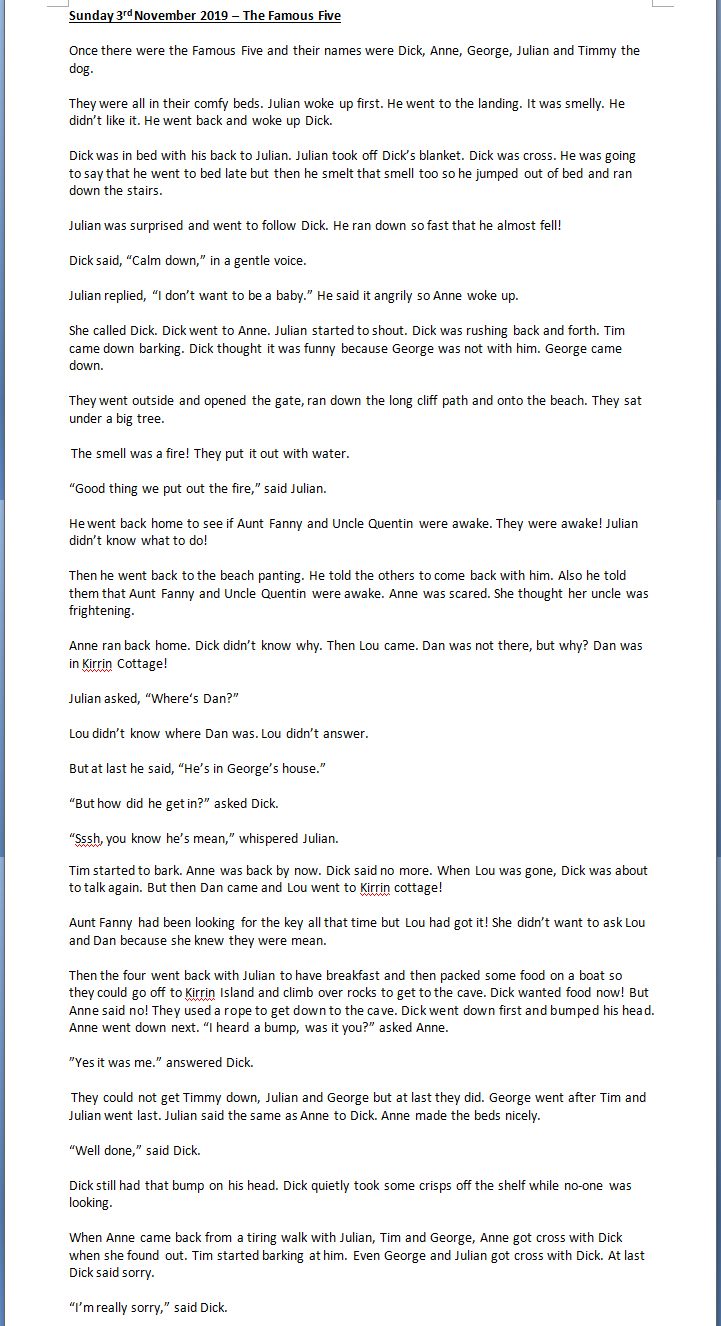
After the diary entries we did together, F was feeling inspired and wrote her own mini Famous Five adventure in one of her notebooks. 😍
So I decided to take advantage of this as a learning opportunity. 😂
While the other three were busy playing, I spoke to M by herself to see if she wanted to write a Famous Five story too... We talked about a possible plot: Where could they be? What could the problem be? How do they solve it? Then I gave her some time to write her own story as F started typing hers up on the laptop (the opportunity to type on the laptop if she wrote a story was a good incentive for M!) - Alhamdulillah once she started she got really into it. At this moment, they've both handwritten around 3 A5 sides in the past two days (F's written 6 including her original adventure! She's now doing chapter 2. 😁
The plan is for them to practise typing in MS Word and then practise editing their work. I'll use this opportunity to cover paragraphs, connectives and expanded noun phrases - the only targets they have left from the Year 2 Literacy NC - by going through each concept in turn and giving them the chance to see where they can include each thing in their stories, insha'Allah.
Fri 15th Nov 2019
MashaAllah, their typing has really improved over the last week, both in speed and accuracy. They're only allowed on the laptop in half an hour chunks and maximum of twice a day, so I think keeping the time limited helps to retain the novelty factor and so their motivation.
They're both really into their stories now too, getting their notebooks out and writing in them every chance they get! I'm not at all fussed about story structure at this stage, so the pacing and content isn't entirely there - I'm just happy to see them both loving to write and being able to write continuously for extended periods of time! Their writing style has definitely been influenced (in a good way!) by Enid Blyton's and their sentence structures, punctuation and spelling have naturally improved the more they write, as they reread their work or ask me how to spell something after they've tried and it's not come out looking right.
This week I wanted to recap editing skills and focus on paragraphs. Both girls had typed up a good chunk on the laptop, so I increased the font size and line spacing then printed out what they'd done so far.
First, I asked them to choose a highlighter and to read through their work highlighting any errors (spelling, grammar, punctuation) they may have made.
Next, I talked to them about adding more detail to make their descriptions more interesting. How? Adjectives and adverbs! I had them highlight all the interesting descriptive words they'd used in a different colour. M discovered she hadn't many at all and F thought she should have used more too, so individually I talked to them about where they might add more description in a way that adds to the story (trying not to fall into the trap of writing to tick off boxes, which can lead to awkward sounding phrases which although grammatically correct spoil the story's flow!) and we jotted down words they could insert next to highlighted nouns of their choice.
Finally, we talked about paragraphs again. We reread half a page from the current Famous Five book we're on and discussed where the new paragraphs began - when the topic changed or when someone different started speaking. With a different coloured highlighter, I helped them mark onto their paper where they thought they should start a new line in their writing.
To finish, they took it in turns to edit the highlighted parts onto the laptop. With the rest of their half an hour time slot they were able to continue copy typing the rest of their story - but now they were expected to edit as they typed rather than just copy the mistakes! Most importantly, I wanted them to focus on paragraphs, which is what I would be checking for when I saved their work. MashaAllah they quickly picked up this skill and all their typing since has had new lines in the correct places.
Wed 20th Nov 2019
This week I wanted to focus on expanded noun phrases. Their paragraphs are fine when copy typing - they remember to add them in with no prompting from myself - but when writing in their notebooks they become so absorbed in their ideas that they forget to put them in! At the very least, I've told them I expect to see a new line everytime someone new speaks... So we'll see how that goes InshaAllah!
On the whiteboard I wrote the simple sentence "The sun shone." and had the girls label the noun and verb. I explained to them what a phrase was, highlighting it in a different colour, and what the word expanded means, i.e. to get bigger. So an expanded noun phrase is making the noun phrase bigger. How? By adding more detail? How? By using adjectives!
I had them come up with some suitable adjectives for our simple sentence :
The shining sun shone.
The bright sun shone.
The burning sun shone.
We talked about the effect changing the adjective had on us as the reader and why the first example wasn't very good, even though it made sense. It didn't add anything to the description! So they needed to think about what their adjective adds in helping the reader imagine what you want them to imagine...
The girls then continued to take turns typing their stories (and writing their stories!) and I told them I would be checking to see which interesting adjectives (or maybe adverbs) they would be using to help improve their stories.
Tue 3rd Dec
They've been writing their stories for almost a month now and not showing any signs of stopping! MashaAllah!
The plots are long and convoluted, making sense but not refined, with a lot of random subplots and unresolved ideas throughout... But the point is both stories flow, have been a great vehicle for teaching grammar and sentence level work, and the girls are enjoying themselves doing it!
Yesterday we spent the whole day outside - football in the morning then Thinktank with friends in the afternoon - the latter being a little spur of the moment compared to what I originally had planned to do... So I commented that the girls had spent that day not really doing any "work". But actually, they'd spent the time I was getting dinner ready writing their stories in their notebooks, so I corrected myself to say they'd spent a day playing and the only work they'd done was Literacy - to which M said, no, they hadn't done any work because writing their stories was still playing to them! Well, they do it whenever they feel like it without any prompting from myself so I suppose she's right. 😂
As a result of their story writing, the twins can now write in paragraphs confidently and are familiar with the different grammar patterns of direct speech (at the start of a sentence, end of a sentence, new line new speaker), understand the editing process and are aware of the need to include interesting descriptions to make their writing more compelling.
I think I might look at clauses and subclauses next with them, InshaAllah, as they've used some in their writing naturally so there's no harm in labelling what they are? 🙃
After the diary entries we did together, F was feeling inspired and wrote her own mini Famous Five adventure in one of her notebooks. 😍
So I decided to take advantage of this as a learning opportunity. 😂
While the other three were busy playing, I spoke to M by herself to see if she wanted to write a Famous Five story too... We talked about a possible plot: Where could they be? What could the problem be? How do they solve it? Then I gave her some time to write her own story as F started typing hers up on the laptop (the opportunity to type on the laptop if she wrote a story was a good incentive for M!) - Alhamdulillah once she started she got really into it. At this moment, they've both handwritten around 3 A5 sides in the past two days (F's written 6 including her original adventure! She's now doing chapter 2. 😁
The plan is for them to practise typing in MS Word and then practise editing their work. I'll use this opportunity to cover paragraphs, connectives and expanded noun phrases - the only targets they have left from the Year 2 Literacy NC - by going through each concept in turn and giving them the chance to see where they can include each thing in their stories, insha'Allah.
Fri 15th Nov 2019
MashaAllah, their typing has really improved over the last week, both in speed and accuracy. They're only allowed on the laptop in half an hour chunks and maximum of twice a day, so I think keeping the time limited helps to retain the novelty factor and so their motivation.
They're both really into their stories now too, getting their notebooks out and writing in them every chance they get! I'm not at all fussed about story structure at this stage, so the pacing and content isn't entirely there - I'm just happy to see them both loving to write and being able to write continuously for extended periods of time! Their writing style has definitely been influenced (in a good way!) by Enid Blyton's and their sentence structures, punctuation and spelling have naturally improved the more they write, as they reread their work or ask me how to spell something after they've tried and it's not come out looking right.
This week I wanted to recap editing skills and focus on paragraphs. Both girls had typed up a good chunk on the laptop, so I increased the font size and line spacing then printed out what they'd done so far.
First, I asked them to choose a highlighter and to read through their work highlighting any errors (spelling, grammar, punctuation) they may have made.
Next, I talked to them about adding more detail to make their descriptions more interesting. How? Adjectives and adverbs! I had them highlight all the interesting descriptive words they'd used in a different colour. M discovered she hadn't many at all and F thought she should have used more too, so individually I talked to them about where they might add more description in a way that adds to the story (trying not to fall into the trap of writing to tick off boxes, which can lead to awkward sounding phrases which although grammatically correct spoil the story's flow!) and we jotted down words they could insert next to highlighted nouns of their choice.
Finally, we talked about paragraphs again. We reread half a page from the current Famous Five book we're on and discussed where the new paragraphs began - when the topic changed or when someone different started speaking. With a different coloured highlighter, I helped them mark onto their paper where they thought they should start a new line in their writing.
To finish, they took it in turns to edit the highlighted parts onto the laptop. With the rest of their half an hour time slot they were able to continue copy typing the rest of their story - but now they were expected to edit as they typed rather than just copy the mistakes! Most importantly, I wanted them to focus on paragraphs, which is what I would be checking for when I saved their work. MashaAllah they quickly picked up this skill and all their typing since has had new lines in the correct places.
Wed 20th Nov 2019
This week I wanted to focus on expanded noun phrases. Their paragraphs are fine when copy typing - they remember to add them in with no prompting from myself - but when writing in their notebooks they become so absorbed in their ideas that they forget to put them in! At the very least, I've told them I expect to see a new line everytime someone new speaks... So we'll see how that goes InshaAllah!
On the whiteboard I wrote the simple sentence "The sun shone." and had the girls label the noun and verb. I explained to them what a phrase was, highlighting it in a different colour, and what the word expanded means, i.e. to get bigger. So an expanded noun phrase is making the noun phrase bigger. How? By adding more detail? How? By using adjectives!
I had them come up with some suitable adjectives for our simple sentence :
The shining sun shone.
The bright sun shone.
The burning sun shone.
We talked about the effect changing the adjective had on us as the reader and why the first example wasn't very good, even though it made sense. It didn't add anything to the description! So they needed to think about what their adjective adds in helping the reader imagine what you want them to imagine...
The girls then continued to take turns typing their stories (and writing their stories!) and I told them I would be checking to see which interesting adjectives (or maybe adverbs) they would be using to help improve their stories.
Tue 3rd Dec
They've been writing their stories for almost a month now and not showing any signs of stopping! MashaAllah!
The plots are long and convoluted, making sense but not refined, with a lot of random subplots and unresolved ideas throughout... But the point is both stories flow, have been a great vehicle for teaching grammar and sentence level work, and the girls are enjoying themselves doing it!
Yesterday we spent the whole day outside - football in the morning then Thinktank with friends in the afternoon - the latter being a little spur of the moment compared to what I originally had planned to do... So I commented that the girls had spent that day not really doing any "work". But actually, they'd spent the time I was getting dinner ready writing their stories in their notebooks, so I corrected myself to say they'd spent a day playing and the only work they'd done was Literacy - to which M said, no, they hadn't done any work because writing their stories was still playing to them! Well, they do it whenever they feel like it without any prompting from myself so I suppose she's right. 😂
As a result of their story writing, the twins can now write in paragraphs confidently and are familiar with the different grammar patterns of direct speech (at the start of a sentence, end of a sentence, new line new speaker), understand the editing process and are aware of the need to include interesting descriptions to make their writing more compelling.
I think I might look at clauses and subclauses next with them, InshaAllah, as they've used some in their writing naturally so there's no harm in labelling what they are? 🙃
Tuesday, 19 November 2019
Light & Dark - The Sun / Bouncing Light
Working through the suggested targets from the National Curriculum, we discussed the importance of not looking directly into bright lights and why (we took turns to look into each other's eyes while looking in and away from a light to see how the pupil grows and shrinks accordingly) and in particular the sun, then I asked the girls to draw a simple poster to summarise this information.
This is their first time making a poster (they didn't even know what one was!) so we first skimmed through some of their non-fiction books to talk about which layout features made the text inviting and easy to read, so which features did they want to copy for their poster... We came up with the use of pictures, bright colours, boxes and borders and simple sentences. I showed them a piece of A4 paper and asked them which was more effective - to squeeze everything into one corner or to spread it out over the whole page by writing and drawing larger than usual... They answered with the second option! Then I left them to it as A needed a nap.
Tbh I wasn't expecting masterpieces from them since they were doing it for the first time and unsupervised, so I was pleasantly surprised with the results!
The next week we focused on the fact light bounces off everything (revision: which is how we see things) but shiny surfaces seem to reflect more (not getting into the full details at this stage!). We talked about which kinds of materials tend to be shiny (glass or metal, sometimes plastic... Water! e.g. puddles, the sea) and focused in particular on mirrors. How do they work? We can see our reflections because the light bounces off the mirror's shiny surface.
In the 6th Famous Five book, Five on Kirrin Island Again, Julian advises his uncle to use the sun's light and a mirror to signal from far away (we learnt a new word here: heliographing!) so I thought it would be fun for the girls to try and do some heliographing of their own.
We were fortunate with the weather this week in November and headed to the Botanical Gardens where I knew they would have a safe, wide open space in which to have a go! I gave them a mirror each, and a walkie talkie so we wouldn't have to keep shouting to each other, and spread out over the main lawn with one twin at the top of the hill, one at the bottom near the bandstand, and myself, Z and A wandering around in between. It was a little tricky for them to catch the sun's light in a way for their sister to be able to see it, but a great practical experiment into understanding how light travels in straight lines and a subtle introduction to the idea of angles of incidence/reflection. 😁
After a good play around with mirror signals, the girls did some backwards walking through the gardens using the mirrors to see where they were going! And, of course, we ended our day with a trip to the playground. 😀
This is their first time making a poster (they didn't even know what one was!) so we first skimmed through some of their non-fiction books to talk about which layout features made the text inviting and easy to read, so which features did they want to copy for their poster... We came up with the use of pictures, bright colours, boxes and borders and simple sentences. I showed them a piece of A4 paper and asked them which was more effective - to squeeze everything into one corner or to spread it out over the whole page by writing and drawing larger than usual... They answered with the second option! Then I left them to it as A needed a nap.
Tbh I wasn't expecting masterpieces from them since they were doing it for the first time and unsupervised, so I was pleasantly surprised with the results!
The next week we focused on the fact light bounces off everything (revision: which is how we see things) but shiny surfaces seem to reflect more (not getting into the full details at this stage!). We talked about which kinds of materials tend to be shiny (glass or metal, sometimes plastic... Water! e.g. puddles, the sea) and focused in particular on mirrors. How do they work? We can see our reflections because the light bounces off the mirror's shiny surface.
In the 6th Famous Five book, Five on Kirrin Island Again, Julian advises his uncle to use the sun's light and a mirror to signal from far away (we learnt a new word here: heliographing!) so I thought it would be fun for the girls to try and do some heliographing of their own.
We were fortunate with the weather this week in November and headed to the Botanical Gardens where I knew they would have a safe, wide open space in which to have a go! I gave them a mirror each, and a walkie talkie so we wouldn't have to keep shouting to each other, and spread out over the main lawn with one twin at the top of the hill, one at the bottom near the bandstand, and myself, Z and A wandering around in between. It was a little tricky for them to catch the sun's light in a way for their sister to be able to see it, but a great practical experiment into understanding how light travels in straight lines and a subtle introduction to the idea of angles of incidence/reflection. 😁
After a good play around with mirror signals, the girls did some backwards walking through the gardens using the mirrors to see where they were going! And, of course, we ended our day with a trip to the playground. 😀
Labels:
light & dark,
literacy,
poster,
science,
year 2
Arabic update
The twins have completed Madinah Arabic Reader Book 1 with me and we've just started Book 2, mashaAllah.
Their understanding is pretty good, as we read through the first chapter together and they had no issues with the content.
Current targets:
1) To be able to read more fluently (just need more practise, ideally daily!)
2) To be able to write simple sentences (they can spell words but don't have the confidence to write, especially joined... I need to give them more opportunities to do so!)
One of the grammatical concepts in the current chapter is the idea of the object of a verb in a sentence needing a fatha (and revising the subject needs a dhamma), i.e. "Tuhibbu al-baqaratu al-kitaaba" means "The cow likes the book" [as opposed to "Tuhibbu al-baqarata al-kitaabu" meaning "The book likes the cow"]. So we did some work on the whiteboard to this effect, using different familiar verbs and objects and emphasising that the order of the sentence isn't important, but the meaning comes from the vowel sound on the words.
Then the girls (Z included!) drew and painted a picture of 5 foods they liked to eat (so we could practise the verbs eat, like and want). They painted them with cottonbuds and a dot effect (I'm trying to introduce them to different art techniques where I can within other subjects, as we don't really have a set "Art" time atm!)
Wednesday, 6 November 2019
Seerah timeline (1-5)
Over the years, the girls have built up a good general knowledge to do with the Prophet Muhammad (SAW) - they know who he is and some major events from his life - but we've never done any specific work about him, everything has just been picked up from reading books and everyday discussions. So now the twins have reached Year 2, I thought now would be a good time to create a basic timeline in their heads... They're young enough to absorb the information easily as a foundation for the rest of their lives yet old enough to understand and appreciate what they're learning.
I bought them the book 365 Days with the Prophet Muhammad as an eid gift, with the intention to read through a chapter here and there every other night or so. This didn't happen lol. So I'm using it now as a basis for them to create a timeline of the Prophet (SAW)'s life, which we'll do together over a couple of months as a large wall display, adding to it as we go. I split the Prophet (SAW)'s life into 12 key sections and we're looking at one per week:
1) Birth
2) Childhood
3) Young adult
4) Revelation
5) Secret preaching
6) Open preaching
7) Year of Sadness
8) Isra & Mi'raaj
9) Hijrah
10) Battles
11) Spread of Islam
12) Death
The hardest part of this for me is cutting out the detail... 🙈 Don't want to overwhelm them! The purpose of this exercise is to organise the key events in their heads and to relate them to set dates / the Prophet (SAW)'s age so they can appreciate the timescale between events. I'm sure more detail can be added over the years, insha'Allah!
This is what we have so far:
The format we're following is for me to read select chapters from the book over the first half of the week, then write some questions as prompts on the whiteboard (e.g. "What happened when he was 6?").
They then have to write a fact about that part of his life onto a mini post-it note and when they're done (meaning they've covered what I wanted them to!) the post-its are arranged onto the card strip (I used 4 different shades of green A4 card, split into thirds) and stuck on the wall.
This has been good in a Literacy sense too as we covered the difference between fact and opinion and have also honed our notetaking and summarising skills.
When our whole timeline is complete insha'Allah, I'd like them to revisit it from the start and illustrate each section using different art methods / mediums... So hopefully that will act as a way of revising the important information and help them to remember it better in the long run, rather than illustrating each piece as we go along.
Birth
We revisited the concept of family trees and the related vocabulary in Arabic. We also had a good discussion on milk siblings in Islam.
Childhood
Something which stood out for me this week was the part where Aminah died, all of us ended up with tears in our eyes. We talked about this afterwards and continued to talk about the meanings of the words sympathy and empathy.
Young Adult
We talked about the meaning of trustworthy. Were they trustworthy? I thought they were! So as an illustration of this, I left a big box of sweets open on the living room table and told them I trusted them all not to take any sweets. They could look (and even smell lol) but I trusted them not to eat any - my 6 1/2 year old twin and almost 4 year old girls. I said I wasn't even going to check because I trusted them so much... and besides, Allah would be watching and He would know if I was right or not. Come dinnertime, I asked if they had eaten any and they all said no (MashaAllah! And I'm confident they didn't either) so I gave them some after dinner as a reward for being so good. And, of course, the real reward is with Allah because all their good deeds are being recorded and helping them get closer to Jannah, insha'Allah!
When recounting the story of the black stone, we reenacted lifting something all together using a blanket and moving it from one place to another. This also served as a mini lesson on teamwork!
Revelation
We linked this to the tafseer of Surah Al-'Alaq and also the meaning behind the names of the surahs Al-Muzzammil and Al-Muddatthir as other names for Muhammad (SAW). We also had lots of hugs and talked about how being wrapped up makes us feel safe!
They drew in pencil and painted in watercolours a picture to show some of the things Allah has created - to help them reflect on our blessings similar to how Muhammad (SAW) would reflect on Allah's creation in the cave. Their pictures didn't need to make sense (I drew a panda on the beach! And the perspective didn't matter either) but it could only contain things from nature.
Secret Preaching
I don't think we did any particular activity with this, just lots of discussions on the different sahaba and some more focused work on summarising information, since there was so much covered they couldn't fit it all on one post-it per fact!
1) Birth
2) Childhood
3) Young adult
4) Revelation
5) Secret preaching
6) Open preaching
7) Year of Sadness
8) Isra & Mi'raaj
9) Hijrah
10) Battles
11) Spread of Islam
12) Death
The hardest part of this for me is cutting out the detail... 🙈 Don't want to overwhelm them! The purpose of this exercise is to organise the key events in their heads and to relate them to set dates / the Prophet (SAW)'s age so they can appreciate the timescale between events. I'm sure more detail can be added over the years, insha'Allah!
This is what we have so far:
The format we're following is for me to read select chapters from the book over the first half of the week, then write some questions as prompts on the whiteboard (e.g. "What happened when he was 6?").
They then have to write a fact about that part of his life onto a mini post-it note and when they're done (meaning they've covered what I wanted them to!) the post-its are arranged onto the card strip (I used 4 different shades of green A4 card, split into thirds) and stuck on the wall.
This has been good in a Literacy sense too as we covered the difference between fact and opinion and have also honed our notetaking and summarising skills.
When our whole timeline is complete insha'Allah, I'd like them to revisit it from the start and illustrate each section using different art methods / mediums... So hopefully that will act as a way of revising the important information and help them to remember it better in the long run, rather than illustrating each piece as we go along.
Birth
We revisited the concept of family trees and the related vocabulary in Arabic. We also had a good discussion on milk siblings in Islam.
Childhood
Something which stood out for me this week was the part where Aminah died, all of us ended up with tears in our eyes. We talked about this afterwards and continued to talk about the meanings of the words sympathy and empathy.
Young Adult
We talked about the meaning of trustworthy. Were they trustworthy? I thought they were! So as an illustration of this, I left a big box of sweets open on the living room table and told them I trusted them all not to take any sweets. They could look (and even smell lol) but I trusted them not to eat any - my 6 1/2 year old twin and almost 4 year old girls. I said I wasn't even going to check because I trusted them so much... and besides, Allah would be watching and He would know if I was right or not. Come dinnertime, I asked if they had eaten any and they all said no (MashaAllah! And I'm confident they didn't either) so I gave them some after dinner as a reward for being so good. And, of course, the real reward is with Allah because all their good deeds are being recorded and helping them get closer to Jannah, insha'Allah!
When recounting the story of the black stone, we reenacted lifting something all together using a blanket and moving it from one place to another. This also served as a mini lesson on teamwork!
Revelation
We linked this to the tafseer of Surah Al-'Alaq and also the meaning behind the names of the surahs Al-Muzzammil and Al-Muddatthir as other names for Muhammad (SAW). We also had lots of hugs and talked about how being wrapped up makes us feel safe!
They drew in pencil and painted in watercolours a picture to show some of the things Allah has created - to help them reflect on our blessings similar to how Muhammad (SAW) would reflect on Allah's creation in the cave. Their pictures didn't need to make sense (I drew a panda on the beach! And the perspective didn't matter either) but it could only contain things from nature.
Secret Preaching
I don't think we did any particular activity with this, just lots of discussions on the different sahaba and some more focused work on summarising information, since there was so much covered they couldn't fit it all on one post-it per fact!
Saturday, 2 November 2019
Summer of Year 1 - Autumn of Year 2
A list of some of the things we've done over the last few months... No time for proper updates! SubhanAllah, my youngest brother was diagnosed with stage 4b lymphoma and things were a bit busy and a lot of going back and forth between Bristol, Birmingham and Ipswich. Alhamdulillah, he's finished his chemo course and seems to be doing well (and MashaAllah, the work we've done in Science recently on infection and the human body was really useful in the girls being able to understand pretty quickly why I was upset to hear the news and why we need to make lots of dua that Mamu gets better soon). Next time we visit will be next month, inshaAllah. 😄
So aside from the usual Literacy and Numeracy, guided by the Year 2 NC (going through the list and filling in all the gaps), we did the following:
1) Definition of habitats: research in non-fiction books, identify from fiction books, create a poster of a habitat of choice (including marking locations on a world map) which contained examples of plants and animals found in that habitat. Rehearse and give a presentation of their poster to each other, giving feedback on how to improve, then give an improved presentation to Papa. Convert their posters to PowerPoints (skills: typing, text boxes, inserting images, animations) and show this as a presentation to Papa.
3) Visit to a working water mill, where they grind their own flour and make their own bread - Tide Mill in Woodbridge. We took the train there with Nani, which was an experience in itself! The mill itself was really educational and child friendly. Definitely worth a visit if you're in the area! The girls got to help start the water wheel by turning a handle and follow all the ropes and pulleys to the top of the mill. They were able to identify where the old pulleys should have been connected in the roof for the bags of flour to be lifted through the hatch, and also understood the mechanism behind the cogs turning and affecting each other. While there we also did some bird spotting from the lookout area and talked about how the mill was connected to the river. This led onto discussions to do with water sources and the sea, which inspired some more visits whilst in Ipswich...
4) We went to Felixstowe beach twice - once on the train with Nani during the daytime and another at sunset by car with Papa. Both experiences felt completely different despite being to the same place, which led to some good discussions. On our first trip they had fish & chips and ice-cream on the pier, played in the sand and F was brave enough to paddle in the sea. On the second trip we went for a short stroll on the beach and they played in the sand by the light of some coloured string lanterns hung across the promenade. It was interesting to watch the sunset on the horizon and see how the sky changed colour and then how the sea faded to black so it was impossible to tell where the sea ended and the sky began - the only clues the sea was there at all were a few lights from ships far in the distance. This led to talks about lighthouses and on how vast the sea is.
5) We walked down to Ipswich docks (only 5-10min from my parents' house!) and compared how the water was flowing to the river we saw at Woodbridge. Why? M had the idea that maybe both the water in the docks and the water from Tide Mill would end up in Felixstowe to meet the sea, so we checked on Google maps by zooming out and saw she was right! We didn't have time this visit to see, but I'd like to take them to Orwell Bridge so they can compare how the river looks there to how it was after the docks (and also to the little streams we saw in Holywells Park).
6) Which is the most popular car colour in Ipswich? The twins came up with a method of answering this question (watch the cars on the main road outside Nani's house) and keep a tally chart. We repeated this on two different days and compared the results (the same top three colours but not the same most popular colour on each day!) then turned these results into a bar chart (column addition practise to collate their results from both days). I helped them with this through prompts and questions and then wrote some simple questions about their data for them to answer.
7) We went to a free pizza making workshop at Pizza Express, organised by another home ed mum. The 3 eldest girls learnt a little about Italy and why a margarita has that name (the colours of the Italian flag represented by the toppings), tasted some pizza toppings then made their own margaritas on a pre-made base. The next week they wanted to make pizza at home from scratch, so I found a simple dough using Greek yoghurt and flour they could do independently. They made the dough themselves while I helped with the oven parts and making the sauce (tomato puree, oil & herbs). They put all the toppings on themselves and decided to make tuna, sweetcorn, mozzarella and cheddar.
8) Bake Off inspired baking: taking it in turns to bake cupcakes with me, one person each week. They designed their cupcake on paper first (sponge flavour & decorations) then baked with my guidance (they did measuring themselves for once!). After we all had a turn, we discussed which bake was our favourite and why. Mine was mint chocolate and my favourite lol - will need to post recipe soon inshaAllah!
9) First piece of extended writing in a while... We're currently reading the Famous Five series together and they're really enjoying them, so I used this as a basis for their writing. After a particularly eventful chapter, we did some hotseating on the characters' thoughts/feelings then I modelled writing a simple diary entry on A3 paper. Together, we discussed what the features of a diary entry might be and annotated them on the paper. Then the twins wrote their own diary entries as different characters from the book. When they thought they were finished, they referred to the poster and added to their work.
10) Bouncing ball investigation (as M asked why did the ball bounce higher in the kitchen compared to the sitting room?). Discussed in terms of energy (potential, kinetic) and energy being absorbed. Twins came up with ideas on how to test these factors (i.e. strength of throw, height dropped, floor surface) and how to measure - describe in words or use tape measure? Both ways difficult but tape measure was preferred option! One of the results didn't match our predictions, so we did some further investigations explore why. M came up with hypothesis 1 and F with hypothesis 2, with them both working together to think of how we could test each one. We put both ideas together to come up with a reason to explain why that one result didn't match.
Labels:
animals,
art,
baking,
data handling,
experiment,
forces,
geography,
history,
ICT,
literacy,
maths investigation,
numeracy,
plants,
rivers,
science,
year 1,
year 2
Subscribe to:
Comments (Atom)