Showing posts with label seerah. Show all posts

Friday, 20 December 2019

Seerah Timeline (9-12)

Continued from this post...


This is a bit of a dull post as we didn't do much in terms of extra activities for these final sections of the seerah - just the usual read from the book and summarise on Post-It notes via questions on the whiteboard.

Just posting for completion's sake!

Alhamdulillah the girls really enjoyed the past few months and learning more about the Prophet Muhammad (SAW). I'm pleased, as I think they now have a good foundation to build upon InshaAllah - and I learnt lots during this time too!

I plan to take a short break from the seerah over the next term so we can refocus on Allah's names InshaAllah, then we can come back to their timeline as an art project - revising what they wrote and thinking of a suitable illustration for each section. 🌟

Tuesday, 26 November 2019

Maps and Scales

Following on from our seerah work on the Isra' and Mi'raaj, I thought now would be a nice time to look at the big atlas (they've only used their junior atlas so far) and introduce them to the concept of scales.

First, we revised which units are used for measuring length/distance and compared them to each other i.e. how many mm in a cm, cm in a m, m in a km. So which unit would be the most sensible for measuring the distance between Makkah and Jerusalem? They chose km. 😁

Then I showed them the atlas and told them we could use it to calculate the actual distance between those two places. Nowadays, we can easily use the internet to find out the answer - but before that technology existed, this is what we would have done instead!

They used the contents page to help them find the right page in the atlas (they knew they needed to look in either Asia or Africa) and then found Makkah and Jerusalem on the map. I asked them to measure the distance - what would they need? A ruler. At first they tried to do it in cm and said "around 6cm", so I told them to use mm - which is another new skill for them today! M said 62mm and F 64mm, so I said we'd go in between and say it's 63mm.


So is the distance between Makkah and Jerusalem 63mm?? M laughed and said her hand was bigger than that! So I pointed out the scale at the bottom of the page and explained this to them: the map was drawn to scale so that every 1cm actually meant 200km in real life!

The next bit of maths I did on the whiteboard and had them help with the arithmetic, but I didn't expect them to follow along with the method... So we calculated that if 1cm = 200km then 1mm = 20km. 1mm x 20 = 20km, so 63mm x 20 = 1260km. So the distance between Makkah and Jerusalem must be around 1260km.

Was it? We typed it into Google to check and found the answer given to be 1486km! Which is pretty close! We'd recently done work on rounding, so I had them round the two answers to the nearest 100km, i.e. 1300km and 1500km, and they agreed these were pretty similar.

Next, I asked them to find the page of the UK so we could calculate some distances between e.g. Birmingham and Ipswich.

M found the page quickly and they enjoyed looking at the map for a few minutes, pointing out familiar places: Birmingham, Ipswich, Felixstowe, Woodbridge, Leicester, Nottingham (where Papa's at work today!), London...

Then they repeated what they did before, in turn, and measured the distance between Birmingham and Ipswich to be 106mm. They both agreed at the same distance this time.


I asked them if Birmingham and Ipswich were further away from each other than Makkah and Jerusalem then, because 106mm was more than 63mm? They both laughed and said no, of course not. 😂 I prompted them by asking if the scale of the maps on both pages was the same or different then and they correctly answered it must be different. 👍

We did some more calculations on the whiteboard (again, not expecting them to follow the method!) and worked out that Ipswich is 265km away from Birmingham. Google came up with 264.2km, which they were very pleased with! 😁😁

Finally, we compared the two distances with each other by rounding... So Makkah to Jerusalem was around 1500km and Birmingham to Ipswich was around 300km... So how many times more is the distance between Makkah and Jerusalem, i.e. how far Prophet Muhammad (SAW) travelled in one night compared to when we go to visit Nani's house? With a bit of prompting (mainly me scaling the numbers down by dividing by 100!) they were happy it was 5 times more.

So if it takes us around 3 hours to get to Nani's house by car, how long would it take us by car to get to Jerusalem from Makkah? F quite quickly understood we needed to multiply 3 hours by 5, so 15 hours. This gave them some kind of tangible idea of how far the Prophet (SAW) travelled and why the disbelievers found it so hard to believe him!

How long did they say it should take? 1 month, i.e. around 30 days by camel. So if we were to travel the distance to Ipswich by camel, as they would have done in those days, how long would it take us? This was a little more difficult but they worked out they would need to divide 30 by 5, since the difference in the journey length was 5 times, i.e. 6 days. Can you imagine taking 6 days to get to Nani's house! But nowadays we can just get in the car and drive in only 2.5-3hrs! 😱

We finished there, but I noticed the two of them poring over the atlas together while I was getting lunch ready, MashaAllah. 😆💕

Thursday, 21 November 2019

Seerah timeline (6-8)

Continued from this post...


Open Preaching

Coincidentally, the week we covered this part of the seerah, the Big Life Journal email that week (I recommend signing up to the free emails if you haven't already!) happened to be linked with a similar lesson to do with overcoming challenges: "Trees stand strong despite high winds because their roots are deep. Similarly, we can stand strong despite the challenges in our lives because we have deep roots which support us: loving people, thoughts, beliefs, values, and so on."

So as part of our reflection on this part of the Prophet (SAW)'s life, we completed the week's Big Life Journal activity together and stuck the finished poster in their bedroom, while reminding ourselves of the Muslims at the time going through their challenges (i.e. ridicule, torture, the boycott, etc.) but never giving up their faith.


We coloured a quarter of the poster each, since it printed on to 4 A4 sheets it was simplest to divide up the work this way (myself, the twins and Z) - and this also represented teamwork and the fact we all share the same roots with each other. I took this opportunity to teach the girls about blending and hues by having us all use colouring pencils. I demonstrated applying different pressure using the same pencil and the effect it had on the colour, as well as colouring lightly with two colours on top of each other so the change between two colours isn't so apparent.

Year of Sadness

We talked about why this time of the Prophet (SAW)'s life is known is the Year of Sadness/Sorrow, how he must have been feeling and why he was able to continue his mission despite that.

Continuing the theme of being strong like a tree, we compared this sadness to a huge challenge and Allah's love and Muhammad (SAW)'s strong faith as being his roots.

I Googled some random photos of landscapes to show the children, first "summer day landscape" then "icy landscape" and asked them how the pictures made them feel - what mood did they give and did they make you feel warm or cold? Then we Googled "flower field landscape" and talked about why these photos made us feel warm and happy - what did they have in common? Bright colours... What kinds of colours? Reds, oranges, yellows and they also said bright blues and greens. I Googled "cold colours landscapes" to show the girls and we talked about why these photos made us feel cold... They were mostly blue, purple and grey colours and they were dull not bright. Finally I googled "warm vs cold colours" to show them a diagram to illustrate that, yes, they were right and the red-orange-yellow side of the colour wheel is associated with warmth whereas the green-blue-purple side is cold.

Bringing them back to the main topic, I asked them if we were to paint something to represent this time of the Prophet (SAW)'s life, which kinds of colours would give the right mood? They answered the cold colours.

As we were talking, I was still scrolling through the example pictures on Google and we came across this one:

I really liked how it showed the contrast between the warm/cold colours in one picture. That's when I had the idea to create a similar painting rather than just doing one to convey a sad mood, and to link it to the growth mindset idea of being strong like a tree.

On a piece of A4 card, I demonstrated with Z how to draw round their hand as if it were the roots of a tree, their arm the trunk, and to flip the paper round to draw in the outline of the leaves at the top. This tree represented them and they were going to colour it in with all warm colours to show their strength, whereas outside the tree they were only going to use cold colours to represent the challenges they might come across - just as the Prophet Muhammad (SAW) still had Islam keeping him strong and warm inside despite everything going on outside him (e.g. Abu Talib and Khadijah passing away, being treated even worse by the non-Muslims, being stoned at Taif) which actually wanted to make him feel very sad and cold.

Because A needed her nap just then and I couldn't leave them unsupervised with the paints, the twins and Z agreed to use wax crayons to colour their tree and save the watercolors for the background. I said this was a good idea because the wax crayons would stand out more against the paint. They chose what they thought were the warm coloured crayons from the box, including some pinks and purpley-reds. I didn't correct them as I wanted them to experiment with the colours and see if they gave the desired effect... Once they were done colouring the tree it really did give a warm feeling overall, but once they painted in their backgrounds suddenly the purpley-reds stood out as being cold! We talked about why (the background colours made the purpley-reds look more purple) and they decided to go over these parts of their trees with orange and yellow paint, which helped make their tree feel warm again overall. A mistake which turned into a learning experience, and another thing to illustrate the importance of mistakes in helping us grow!


Isra' & Mi'raaj

I thought there wasn't a much detail in the 365 Days book as I would have liked, so I looked through the other books we had and was pleased to see this part of the seerah covered a little more in book 3 of the Safar series. So I read both the chapter from this book as well as the relevant pages in the 365 Days book for the girls to then write their fact summaries.

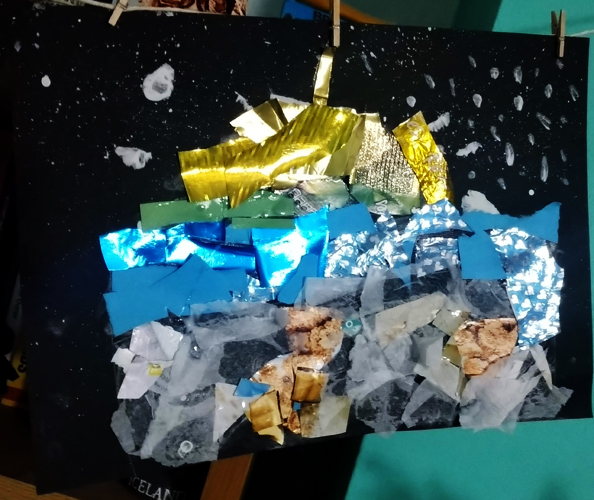
Bringing in our work on shiny surfaces and light reflecting, I thought it would be nice to do a collage of the golden dome at al-Aqsa. I read the chapter from Goodnight Stories with the Prophet Muhammad as a recap (we did this the following day) and the girls talked about which materials would be good to create the shiny golden effect of the dome.

We've not done any proper collaging before, so this was a good opportunity to cover another new thing from the art curriculum I shared in a previous post!

I left this page from the book open as inspiration:


We also looked at some photos of Al-Aqsa from Google and talked about how to draw it simply - they came up with a long rectangle with a semi-circle on top; the bottom half of the rectangle was grey/brown colours, the top half was blue/greys, then there was a thin stripe of greeny colours and finally the golden dome.

They decided to use black card for their picture and I demonstrated how to fill the paper with a simple outline on Z's card. Then we talked about how to achieve a starry sky effect and I told them about splatter painting.

First, they tried dipping their paintbrushes in white paint and flicking their wrist to get the paint to splat onto the background... It was a little difficult to get a strong enough flick and to not accidentally touch the paintbrush to the card! Then they tried running their finger through the bristles and found this a lot easier to flick paint onto their picture - but the stars effect was smaller. They also used a small paintbrush to dot stars on too (Z only wanted to dot with the paintbrush!).

While the paint dried, we looked through our scrap paper and old supermarket magazines (free from the till!) to choose materials which matched the colours they wanted. I demonstrated how to rip the pieces into smaller ones (telling them they could cut with scissors if preferred) and laid them out over one of their pictures. We talked about which looked more effective: lots of different smaller different pieces or just one big piece cut to size... They preferred the first option!

After around 1 hour of independent work, the three ended up with these:


(F, M, Z)

Wednesday, 6 November 2019

Seerah timeline (1-5)

Over the years, the girls have built up a good general knowledge to do with the Prophet Muhammad (SAW) - they know who he is and some major events from his life - but we've never done any specific work about him, everything has just been picked up from reading books and everyday discussions. So now the twins have reached Year 2, I thought now would be a good time to create a basic timeline in their heads... They're young enough to absorb the information easily as a foundation for the rest of their lives yet old enough to understand and appreciate what they're learning.

I bought them the book 365 Days with the Prophet Muhammad as an eid gift, with the intention to read through a chapter here and there every other night or so. This didn't happen lol. So I'm using it now as a basis for them to create a timeline of the Prophet (SAW)'s life, which we'll do together over a couple of months as a large wall display, adding to it as we go. I split the Prophet (SAW)'s life into 12 key sections and we're looking at one per week:

1) Birth
2) Childhood
3) Young adult
4) Revelation
5) Secret preaching
6) Open preaching
7) Year of Sadness
8) Isra & Mi'raaj
9) Hijrah
10) Battles
11) Spread of Islam
12) Death

The hardest part of this for me is cutting out the detail... 🙈 Don't want to overwhelm them! The purpose of this exercise is to organise the key events in their heads and to relate them to set dates / the Prophet (SAW)'s age so they can appreciate the timescale between events. I'm sure more detail can be added over the years, insha'Allah!

This is what we have so far:


The format we're following is for me to read select chapters from the book over the first half of the week, then write some questions as prompts on the whiteboard (e.g. "What happened when he was 6?").


They then have to write a fact about that part of his life onto a mini post-it note and when they're done (meaning they've covered what I wanted them to!) the post-its are arranged onto the card strip (I used 4 different shades of green A4 card, split into thirds) and stuck on the wall.

This has been good in a Literacy sense too as we covered the difference between fact and opinion and have also honed our notetaking and summarising skills.

When our whole timeline is complete insha'Allah, I'd like them to revisit it from the start and illustrate each section using different art methods / mediums... So hopefully that will act as a way of revising the important information and help them to remember it better in the long run, rather than illustrating each piece as we go along.

Birth

We revisited the concept of family trees and the related vocabulary in Arabic. We also had a good discussion on milk siblings in Islam.

Childhood

Something which stood out for me this week was the part where Aminah died, all of us ended up with tears in our eyes. We talked about this afterwards and continued to talk about the meanings of the words sympathy and empathy.

Young Adult

We talked about the meaning of trustworthy. Were they trustworthy? I thought they were! So as an illustration of this, I left a big box of sweets open on the living room table and told them I trusted them all not to take any sweets. They could look (and even smell lol) but I trusted them not to eat any - my 6 1/2 year old twin and almost 4 year old girls. I said I wasn't even going to check because I trusted them so much... and besides, Allah would be watching and He would know if I was right or not. Come dinnertime, I asked if they had eaten any and they all said no (MashaAllah! And I'm confident they didn't either) so I gave them some after dinner as a reward for being so good. And, of course, the real reward is with Allah because all their good deeds are being recorded and helping them get closer to Jannah, insha'Allah!

When recounting the story of the black stone, we reenacted lifting something all together using a blanket and moving it from one place to another. This also served as a mini lesson on teamwork!

Revelation

We linked this to the tafseer of Surah Al-'Alaq and also the meaning behind the names of the surahs Al-Muzzammil and Al-Muddatthir as other names for Muhammad (SAW). We also had lots of hugs and talked about how being wrapped up makes us feel safe!

They drew in pencil and painted in watercolours a picture to show some of the things Allah has created - to help them reflect on our blessings similar to how Muhammad (SAW) would reflect on Allah's creation in the cave. Their pictures didn't need to make sense (I drew a panda on the beach! And the perspective didn't matter either) but it could only contain things from nature.


Secret Preaching

I don't think we did any particular activity with this, just lots of discussions on the different sahaba and some more focused work on summarising information, since there was so much covered they couldn't fit it all on one post-it per fact!